Advertisements
Advertisements
प्रश्न
Explain with the help of a labelled circuit diagram, how you will find the resistance of a combination of three resistors of resistances R1, R2 and R3 joined in parallel.
Advertisements
उत्तर

Let the resistance of the three resistors be R1, R2 and R3, respectively. Let their combined resistance be R. Let the total current flowing in the circuit be I and the strength of the battery be V. Then from Ohm's law, we have:
V = IR .....(1)
We know that when the resistors are connected in parallel, the potential drop across each resistance is the same.
Therefore:
I = I1 + I2 + I3
I = V/R1 + V/R2 + V/R3
I = V/(1/R1 + 1/R2 + 1/R3) ...... (2)
From equations (1) and (2) we have:
1/R = 1/R1 + 1/R2 + 1/R3
APPEARS IN
संबंधित प्रश्न
Complete the following :-
(c)

With a neat labelled diagram and derive the equation for three resistances connected in parallel.
An electric lamp of 100 Ω, a toaster of resistance 50 Ω, and a water filter of resistance 500 Ω are connected in parallel to a 220 V source. What is the resistance of an electric iron connected to the same source that takes as much current as all three appliances, and what is the current through it?
Show how would you join three resistors, each of resistance 9 Ω so that the equivalent resistance of the combination is
1) 13.5
2) 6 Ω
Explain with diagram what is meant by the "series combination" and "parallel combination" of resistances. In which case the resultant resistance is : (i) less, and (ii) more, than either of the individual resistances?
The figure given below shows three resistors?
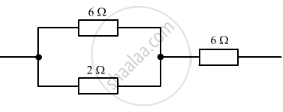
Their combined resistance is:
(a) `1 5/7`Ω
(b) `14` Ω
(c) `6 2/3` Ω
(d) `7 1/2` Ω
Show with the help of diagrams, how you would connect three resistors each of resistance 6 Ω, so that the combination has resistance of (i) 9 Ω (ii) 4 Ω.
Two resistances when connected in parallel give resultant value of 2 ohm; when connected in series the value becomes 9 ohm. Calculate the value of each resistance.
If current flows through two lamps arranged:
(a) in series,
(b) in parallel,
and the filament of one lamps breaks, what happens to the other lamp? Explain your answer.
Two resistors having resistance 4𝛀 and 6𝛀 are connected in parallel. Find their equivalent resistance.
A combination consists of three resistors in series. Four similar sets are connected in parallel. If the resistance of each resistor is 2 ohm, find the resistance of the combination.
A uniform wire with a resistance of 27 Ω is divided into three equal pieces and then they are joined in parallel. Find the equivalent resistance of the parallel combination.
The circuit diagram Fig shows three resistors 2 Ω, 4 Ω and R Ω connected to a battery of e.m.f. 2 V and internal resistance 3 Ω. If main current of 0.25 A flows through the circuit, find:
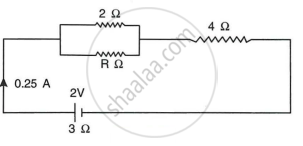
- the p.d. across the 4 Ω resistor,
- the p.d. across the internal resistance of the cell,
- the p.d. across the R Ω or 2 Ω resistors
- the value of R.
Calculate equivalent resistance in the following cases:
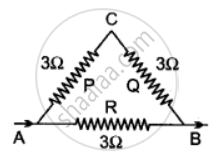
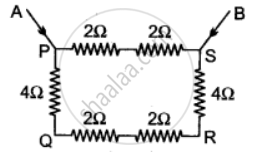
The least resistance obtained by using 2 Ω, 4 Ω, 1 Ω and 100 Ω is:
Three resistors of 1 Ω, 2 Ω and 3 Ω are connected in parallel. The combined resistance of the three resistors should be:
Two resistors having resistance 8 Ω and 12 Ω are connected in parallel. Find their equivalent resistance.
Four resistors each of resistance 5 Ω are connected in parallel. What is the effective resistance?
