मराठी

(A) with the Help of a Circuit Diagram, Obtain the Relation for the Equivalent Resistance of Two Resistances Connected in Parallel. (B) in the Circuit Diagram Shown Below, Find: (I) Total - Science

Advertisements
Advertisements

प्रश्न

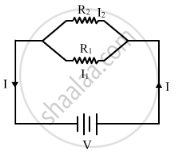
(a) With the help of a circuit diagram, obtain the relation for the equivalent resistance of two resistances connected in parallel.
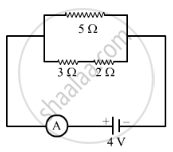
(b) In the circuit diagram shown below, find:

(i) Total resistance.
(ii) Current shown by the ammeter 

बेरीज
Advertisements

उत्तर


Let the individual resistance of the two resistors be R1 and R2 and their combined resistance be R. Let the total current flowing in the circuit be I and strength of the battery be volts. Then, from Ohm's law, we have:
V = IR ... (1)
We know that when resistors are connected in parallel, the potential drop across each resistance is the same.
Therefore:
I  = I1 I2
I = V/R1 + V/R2
I = V/(1/R1 + 1/R2) ... (2)
From the equations (1) and (2) we have:
1/R = 1/R1 + 1/R2  

As shown Resistance 2Ω and 3Ω are in senies 

We know resistance in series arrangement can be obtained as `R=R_1+R_2` 

R=2Ω+3Ω=5Ω 

\[\text{ Since this 5 \Omega is in parallel with another 5 \Omega resistance therefore total resistance can be obtained as }\]

`1/R=1/R_1+1/R_2   "Here"  R_1=5`Ω `R_2=5`Ω 

`1/R=1/5+1/5` 

\[\frac{1}{R} = \frac{2}{5}\]
\[ R = 2 . 5 \Omega\]
`"Total resistance of combination = 2 . 5 \Omega}"`

 The current shown by the ammeter A, i.e. the current in the circuit can be calculated as:  

`I=V/R` 

`I=4/2.5=1.6A` 


shaalaa.com
  या प्रश्नात किंवा उत्तरात काही त्रुटी आहे का?
पाठ 1: Electricity - Exercise 5

APPEARS IN

व्हिडिओ ट्यूटोरियलVIEW ALL [1]

संबंधित प्रश्‍न

In the circuit shown below, the voltmeter reads 10 V. 


(a) What is the combined resistance?
(b) What current flows?
(c) What is the p.d. across 2 Ω resistor?
(d) What is the p.d. across 3 Ω resistor?


You can given one hundred 1 Ω resistors. What is the smallest and largest resistance you can make in a circuit using these?


What happens to the other bulbs in a parallel circuit if one bulb blows off?


How does the heat H produced by a current passing through a fixed resistance wire depend on magnitude of current I?


Which effect of current is utilised in an electric light bulb?


Calculate the equivalent resistance between A and B in the adjacent diagram.


Two resistors of 2.0 Ω and 3.0 Ω are connected (a) in series (b) in parallel, with a battery of 6.0 V and negligible internal resistance. For each case draw a circuit diagram and calculate the current through the battery. 


Draw a schematic diagram of an electric circuit consisting of a battery of two cells each of 1.5 V, 5 Ω, 10 Ω and 15 Ω resistors and a plug key, all connected in series.


Distinguish between an open and a closed circuit.


Is electric potential a scalar or a vector physical quantity?

Explain the meaning of the statement 'the current rating of a fuse is 5 A'.

'A fuse is rated 8 A'. Can it be used with an electrical appliance of rating 5 kW, 200 V?

An electric bulb is rated at 220 V, 100 W. What is its resistance? What maximum current can be passed through it?

State two important precautions you should observe while using electricity?

Electrical power P is given by the expression P = (Q × V) ÷ time

(a) What do the symbols Q and V represent?

(b) Express the power P in terms of current and resistance explaining the meanings of symbols used there in.


An electric bulb is marked '100 W, 250 V'. What information does this convey?


An electric bulb is rated 250 W, 230 V. 

  1. the energy consumed in one hour, and
  2. the time in which the bulb will consume 1.0 kWh energy when connected to 230 V mains.

State whether the following statement is True or False:

The SI unit of charge is the coulomb. 


Which of the following represents voltage?


What is the rate at which charges flow past a point on a circuit?


Share
Notifications

Englishहिंदीमराठी


      Forgot password?
Use app×