Advertisements
Advertisements
Question
(a) With the help of a circuit diagram, obtain the relation for the equivalent resistance of two resistances connected in parallel.
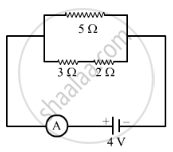
(b) In the circuit diagram shown below, find:
(i) Total resistance.
(ii) Current shown by the ammeter A
Advertisements
Solution
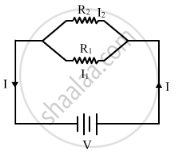
Let the individual resistance of the two resistors be R1 and R2 and their combined resistance be R. Let the total current flowing in the circuit be I and strength of the battery be V volts. Then, from Ohm's law, we have:
V = IR ... (1)
We know that when resistors are connected in parallel, the potential drop across each resistance is the same.
Therefore:
I = I1 + I2
I = V/R1 + V/R2
I = V/(1/R1 + 1/R2) ... (2)
From the equations (1) and (2) we have:
1/R = 1/R1 + 1/R2
As shown Resistance 2Ω and 3Ω are in senies
We know resistance in series arrangement can be obtained as `R=R_1+R_2`
R=2Ω+3Ω=5Ω
\[\text{ Since this 5 \Omega is in parallel with another 5 \Omega resistance therefore total resistance can be obtained as }\]
`1/R=1/R_1+1/R_2 "Here" R_1=5`Ω `R_2=5`Ω
`1/R=1/5+1/5`
\[\frac{1}{R} = \frac{2}{5}\]
\[ R = 2 . 5 \Omega\]
`"Total resistance of combination = 2 . 5 \Omega}"`
The current shown by the ammeter A, i.e. the current in the circuit can be calculated as:
`I=V/R`
`I=4/2.5=1.6A`
APPEARS IN
RELATED QUESTIONS
One coulomb charge is equivalent to the charge contained in:
(a) 2.6 × 10¹⁹ electrons
(b) 6.2 × 10¹⁹ electrons
(c) 2.65 × 10¹⁸ electrons
(d) 6.25 × 10¹⁸ electrons
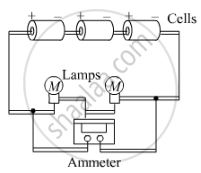
A student made an electric circuit shown here to measure the current through two lamps.
Are the lamps in series or parallel?
(a) Are the lamps in series or parallel?
(b) The student has made a mistake in this circuit. What is the mistake?
(c) Draw a circuit diagram to show the correct way to connect the circuit. Use the proper circuit symbols in your diagram.
If you were going to connect two light bulbs to one battery, would you use a series or a parallel arrangement? Why? Which arrangement takes more current from the battery?
The lamps in a house hold circuit are connected in parallel because:
(a) this way they required less current
(b) if one lamp fails the others remain lit
(c) this way they require less power
(d) if one lamp fails the other also fail
The following table shows the current in Amperes and potential differences in Volts.
- Find the average resistance.
- What will be the nature of the graph between the current and potential difference? (Do not draw a graph.)
- Which law will the graph prove? Explain the law.
| V (volts) | I (amp) |
| 4 | 9 |
| 5 | 11.25 |
| 6 | 13.5 |
Match the pairs.
| ‘A’ Group | ‘B’ Group |
| 1. Free electrons | a. V/R |
| 2. Current | b. Increases the resistance in the circuit |
| 3. Resistivity | c. Weakly attached |
| 4. Resistances in series | d. VA/LI |
An electric oven is rated as 1.5 kW, 250 V. If it is connected to a 250 V mains, calculate the
(a) Current drawn,
(b) Energy consumed in 20 hours,
(c) Cost of energy consumed in 20 hours at the rate of Re. 1 per unit.
A bulb of 40 W is used for 12.5 h each day for 30 days. Calculate the electrical energy consumed.
State the condition when it is advantageous to connect cells in series.
An electric bulb is marked 100 W, 250 V. How much current will the bulb draw if connected to a 250 V supply?
Define the following:
Conventional current
Match the items in column-I to the items in column-II:
| Column - I | Column - II |
| (i) electric current | (a) volt |
| (ii) potential difference | (b) ohm meter |
| (iii) specific resistance | (c) watt |
| (iv) Electrical power | (d) joule |
| (v) electrical energy | (e) ampere |
In semiconductors, the charge carriers are:
The direction of Direct Current (DC) is characterized as:
Common sources of Direct Current (DC) are:
The RMS value of AC is defined as:
