Advertisements
Advertisements
प्रश्न
A uniform wire with a resistance of 27 Ω is divided into three equal pieces and then they are joined in parallel. Find the equivalent resistance of the parallel combination.
Advertisements
उत्तर
When a wire of uniform thickness with a resistance 27 Ω is cut into three equal pieces, the resistance of each piece = `27 /3` = 9 Ω.
Now, the equivalent resistance of three 9 Ω resistors connected in parallel is:
RP = `[1/9 + 1/9 + 1/9]^-1`
= 3 Ω
संबंधित प्रश्न
Complete the following :-
(c)

State the law of combination of resistances in parallel.
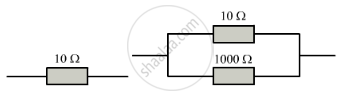
Which of the following arrangement, A or B, has the lower combined resistance?
How will you connect three resistors of resistances 2 Ω, 3 Ω, and 6 Ω to obtain a total resistance of 4 Ω, and 1 Ω?
Are the lights in your house wired in series?
State how are the two resistors joined with a battery when equivalent resistance is less than either of the two resistances.
A combination consists of three resistors in series. Four similar sets are connected in parallel. If the resistance of each resistor is 2 ohm, find the resistance of the combination.
A particular resistance wire has a resistance of 3 ohm per meter. Find the potential difference of the battery which gives a current of 2 A in each of the 1.5 m length when connected in the parallel to the battery (assume that resistance of the battery is negligible).
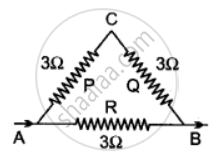
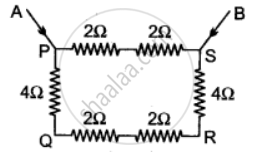
Calculate equivalent resistance in the following cases:
You are given four ammeters A, B, C and D having the least counts mentioned below:
(I) Ammeter A with least count 0.25 A
(II) Ammeter B with least count 0.5 A
(III) Ammeter C with least count 0.05 A
(IV) Ammeter D with least count 0.1 A
Which of the ammeters would you prefer for doing an experiment to determine the equivalent resistance of two resistances most accurately, when connected in parallel?
