Advertisements
Advertisements
प्रश्न
What are the advantages of connecting electrical devices in parallel with the battery instead of connecting them in series?
Advertisements
उत्तर
There is no division of voltage among the appliances when connected in parallel. The potential difference across each appliance is equal to the supplied voltage. The total effective resistance of the circuit can be reduced by connecting electrical appliances in parallel.
APPEARS IN
संबंधित प्रश्न
Differentiate between resistances in series and parallel.
How many 176 Ω resistors (in parallel) are required to carry 5 A on a 220 V line?
The equivalent resistance of the parallel combination of two resistors of 60Ω and 40Ω is _______.
A) 24Ω
(B) 100Ω
(C) 50 Ω
(D) 240Ω
You are given three resistances of 1, 2 and 3 ohms. Shows by diagrams, how with the help of these resistances you can get:
(i) 6 Ω
(ii) `6/1` Ω
(iii) 1.5 Ω
Are the lights in your house wired in series?
Two exactly similar electric lamps are arranged (i) in parallel, and (ii) in series. If the parallel and series combination of lamps are connected to 220 V supply line one by one, what will be the ratio of electric power consumed by them?
State how are the two resistors joined with a battery when equivalent resistance is less than either of the two resistances.
A uniform wire with a resistance of 27 Ω is divided into three equal pieces and then they are joined in parallel. Find the equivalent resistance of the parallel combination.
The circuit diagram Fig shows three resistors 2 Ω, 4 Ω and R Ω connected to a battery of e.m.f. 2 V and internal resistance 3 Ω. If main current of 0.25 A flows through the circuit, find:
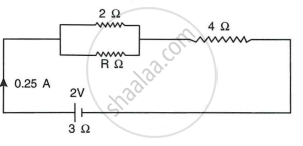
- the p.d. across the 4 Ω resistor,
- the p.d. across the internal resistance of the cell,
- the p.d. across the R Ω or 2 Ω resistors
- the value of R.
A particular resistance wire has a resistance of 3 ohm per meter. Find the potential difference of the battery which gives a current of 2 A in each of the 1.5 m length when connected in the parallel to the battery (assume that resistance of the battery is negligible).
State the S.I. unit of electrical resistance and define it.
Two devices are connected between two points say A and B in parallel. The physical quantity that will remain the same between the two points is:
A coil in the heater consumes power P on passing current. If it is cut into halves and joined in parallel, it will consume power:
You are given four ammeters A, B, C and D having the least counts mentioned below:
(I) Ammeter A with least count 0.25 A
(II) Ammeter B with least count 0.5 A
(III) Ammeter C with least count 0.05 A
(IV) Ammeter D with least count 0.1 A
Which of the ammeters would you prefer for doing an experiment to determine the equivalent resistance of two resistances most accurately, when connected in parallel?
Four resistors each of resistance 5 Ω are connected in parallel. What is the effective resistance?
You have three resistors of values 2 Ω, 3 Ω, and 5 Ω. How will you join them so that the total resistance is less than 1 Ω? Draw a diagram and find the total resistance.
