Advertisements
Advertisements
प्रश्न
How does the resistance of a metallic wire depend on the length of wire?
Advertisements
उत्तर
The resistance of a wire increases with increases in the length of wire (R ∝ l).
संबंधित प्रश्न
With a neat labelled diagram and derive the equation for three resistances connected in parallel.
Show how you would connect two 4 ohm resistors to produce a combined resistance of (a) 2 ohms (b) 8 ohms.
Which of the following combinations have the same equivalent resistance between X and Y?
A battery of e.m.f. 15 V and internal resistance 2 `Omega` is connected to two resistors of 4 ohm and 6 ohm joined.
(i) In series,
(ii) In parallel.
Find in each case the electrical energy spent per minute in 6 ohm resistor.
Tick (✓) the correct choice among the following :
Consider two cases of two parallel current carrying conductors. Current in
th e same direction and currents in th e opposi te directions will produce
The circuit diagram Fig shows three resistors 2 Ω, 4 Ω and R Ω connected to a battery of e.m.f. 2 V and internal resistance 3 Ω. If main current of 0.25 A flows through the circuit, find:
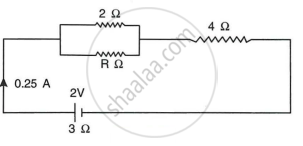
- the p.d. across the 4 Ω resistor,
- the p.d. across the internal resistance of the cell,
- the p.d. across the R Ω or 2 Ω resistors
- the value of R.
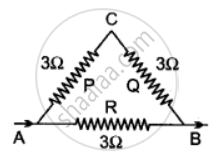
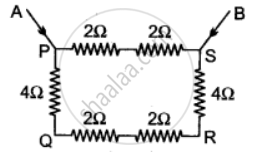
Calculate equivalent resistance in the following cases:
Two resistors when connected in parallel give the resultant resistance of 2 ohms, but when connected in series the effective resistance becomes 9 ohms. Calculate the value of each resistance.
Calculate the current flows through the 10 Ω resistor in the following circuit.

You have three resistors of values 2 Ω, 3 Ω, and 5 Ω. How will you join them so that the total resistance is less than 1 Ω? Draw a diagram and find the total resistance.
