Advertisements
Advertisements
प्रश्न
You are given three resistances of 1, 2 and 3 ohms. Shows by diagrams, how with the help of these resistances you can get:
(i) 6 Ω
(ii) `6/1` Ω
(iii) 1.5 Ω
Advertisements
उत्तर
To get a value of 6 Ω, all the resistors are to be connected in series as shown below:
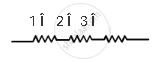
Net resistance, R = R1 + R2 + R3
R = 1 Î + 2 Î + 3 Î = 6 Î
To get a value of 6 / 11 Ω, all the resistors are to be connected in parallel as shown below:
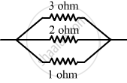
When tree resistance is conencted in parallel their resultant is given by
`1/R=1/R_1+1/R_2+1/R_3`
`R1=3 Ω
`R_2=2`Ω
`R_3=1` Ω
`1/R=1/3+1/2+1/1`
`1/R=(2+3+6)/6`
`1/R=11/6`
`R=6/11`Ω
To get a value of 1.5 Ω, the 1 Ω and 2 Ω resistors should be connected in series and this arrangement should be connected in parallel with the 3 Ω resistor as shown below:
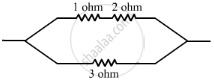
The resistors of resistance 1 Î and 2 Î are in series. Therefore, their net resistance is:
`R=R_1+R_2`
`R=1I+2I`
`R=3I`
This 3 Î is connected in parallel with another 3 Î resistance.
Therefore, net resistance will be:
`1/R=1/R_1+1/R_1`
`1/R=1/3+1/3`
`1/R=2/3`
`R=3/2=1.5`Ω
`1R=1R_1+1R_2 1R=13+131R=23R=32=1.5Ω`
APPEARS IN
संबंधित प्रश्न
Complete the following :-
(b)
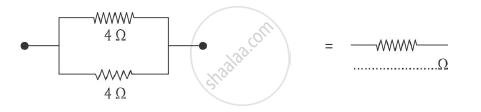
A hot plate of an electric oven connected to a 220 V line has two resistance coils A and B, each of 24 Ω resistances, which may be used separately, in series, or in parallel. What are the currents in the three cases?
The equivalent resistance of the parallel combination of two resistors of 60Ω and 40Ω is _______.
A) 24Ω
(B) 100Ω
(C) 50 Ω
(D) 240Ω
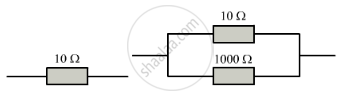
Which of the following arrangement, A or B, has the lower combined resistance?
A resistor of 8 ohms is connected in parallel with another resistor X. The resultant resistance of the combination is 4.8 ohms. What is the value of the resistor X?
State how are the two resistors joined with a battery when equivalent resistance is less than either of the two resistances.
In parallel combination of resistances ______.
Which of the following combinations have the same equivalent resistance between X and Y?
You have three resistors of values 2Ω, 3Ω and 5Ω. How will you join them so that the total resistance is less than 1Ω? Draw diagram and find the total resistance.
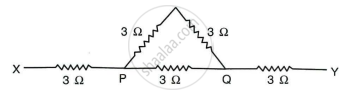
Five resistors, each 3 Ω, are connected as shown in Fig. Calculate the resistance
- between the points P and Q.
- between the points X and Y.
A particular resistance wire has a resistance of 3 ohm per meter. Find the total resistance of three lengths of this wire each 1.5 m long, joined in parallel.
What is the equivalent resistance of 5 equal resistors, each of value 2`Omega` 1 when oonnected in (a) Series ( b) ParaIleI?
Two resistors of resistance 4 Ω and 6 Ω are connected in parallel to a cell to draw 0.5 A current from the cell.
Calculate current in each resistor.
A particular resistance wire has a resistance of 3 ohm per meter. Find the potential difference of the battery which gives a current of 2 A in each of the 1.5 m length when connected in the parallel to the battery (assume that resistance of the battery is negligible).
How does the resistance of a metallic wire depend on the length of wire?
How does the resistance of a metallic wire depend on the thickness of wire?
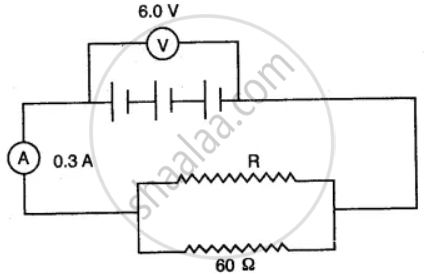
In the figure below, the ammeter A reads 0.3 A. Calculate:
(i) the total resistance of the circuit
(ii) the value of R
(iii) the current flowing through R.
A coil in the heater consumes power P on passing current. If it is cut into halves and joined in parallel, it will consume power:
You are given four ammeters A, B, C and D having the least counts mentioned below:
(I) Ammeter A with least count 0.25 A
(II) Ammeter B with least count 0.5 A
(III) Ammeter C with least count 0.05 A
(IV) Ammeter D with least count 0.1 A
Which of the ammeters would you prefer for doing an experiment to determine the equivalent resistance of two resistances most accurately, when connected in parallel?
Four resistors each of resistance 5 Ω are connected in parallel. What is the effective resistance?
