Advertisements
Advertisements
Question
You are given three resistances of 1, 2 and 3 ohms. Shows by diagrams, how with the help of these resistances you can get:
(i) 6 Ω
(ii) `6/1` Ω
(iii) 1.5 Ω
Advertisements
Solution
To get a value of 6 Ω, all the resistors are to be connected in series as shown below:
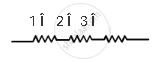
Net resistance, R = R1 + R2 + R3
R = 1 Î + 2 Î + 3 Î = 6 Î
To get a value of 6 / 11 Ω, all the resistors are to be connected in parallel as shown below:
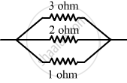
When tree resistance is conencted in parallel their resultant is given by
`1/R=1/R_1+1/R_2+1/R_3`
`R1=3 Ω
`R_2=2`Ω
`R_3=1` Ω
`1/R=1/3+1/2+1/1`
`1/R=(2+3+6)/6`
`1/R=11/6`
`R=6/11`Ω
To get a value of 1.5 Ω, the 1 Ω and 2 Ω resistors should be connected in series and this arrangement should be connected in parallel with the 3 Ω resistor as shown below:
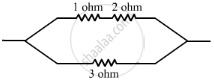
The resistors of resistance 1 Î and 2 Î are in series. Therefore, their net resistance is:
`R=R_1+R_2`
`R=1I+2I`
`R=3I`
This 3 Î is connected in parallel with another 3 Î resistance.
Therefore, net resistance will be:
`1/R=1/R_1+1/R_1`
`1/R=1/3+1/3`
`1/R=2/3`
`R=3/2=1.5`Ω
`1R=1R_1+1R_2 1R=13+131R=23R=32=1.5Ω`
APPEARS IN
RELATED QUESTIONS
Complete the following :-
(b)
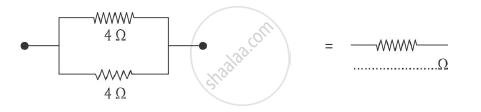
Complete the following :-
(c)

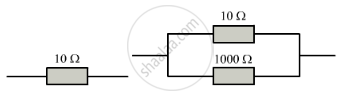
Which of the following arrangement, A or B, has the lower combined resistance?
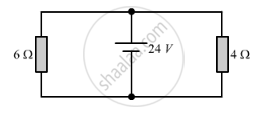
Find the current in each resistor in the circuit shown below:
A resistor has a resistance of 176 ohms. How many of these resistors should be connected in parallel so that their combination draws a current of 5 amperes from a 220 volt supply line?
In the circuit given below:
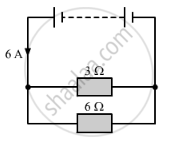
(a) What is the combined resistance?
(b) What is the p.d. across the combined resistor?
(c) What is the p.d. across the 3 Ω resistor?
(d) What is the current in the 3 Ω resistor?
(e) What is the current in the 6 Ω resistor?
Explain with the help of a labelled circuit diagram, how you will find the resistance of a combination of three resistors of resistances R1, R2 and R3 joined in parallel.
Show with the help of diagrams, how you would connect three resistors each of resistance 6 Ω, so that the combination has resistance of (i) 9 Ω (ii) 4 Ω.
How will you connect three resistors of resistances 2 Ω, 3 Ω, and 6 Ω to obtain a total resistance of 4 Ω, and 1 Ω?
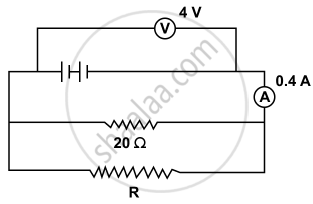
In the following figure calculate:
- the total resistance of the circuit
- the value of R, and
- the current flowing in R.
A battery of e.m.f 16 V and internal resistance 2 Ω is connected to two resistors 3Ω and 6Ω connected in parallel. Find:
- the current through the battery.
- p.d. between the terminals of the battery,
- the current in 3 Ω resistors,
- the current in 6 Ω resistor.
Show how would you connect three resistors, each of resistance 6 O so that
the combination has a resistance of(a) 9 Ω (b) 4 .Ω
What are the advantages of a parallel connection?
A particular resistance wire has a resistance of 3 ohm per meter. Find the potential difference of the battery which gives a current of 2 A in each of the 1.5 m length when connected in the parallel to the battery (assume that resistance of the battery is negligible).
Calculate equivalent resistance in the following cases:
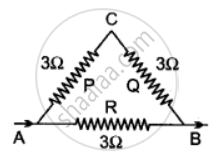
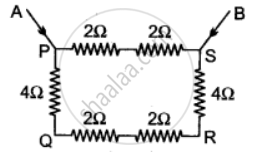
You are given four ammeters A, B, C and D having the least counts mentioned below:
(I) Ammeter A with least count 0.25 A
(II) Ammeter B with least count 0.5 A
(III) Ammeter C with least count 0.05 A
(IV) Ammeter D with least count 0.1 A
Which of the ammeters would you prefer for doing an experiment to determine the equivalent resistance of two resistances most accurately, when connected in parallel?
Three resistors of 6Ω, 4Ω and 4Ω are connected together so that the total resistance is 8Ω. Draw a diagram to show this arrangement and give reason to justify your answer.
A piece of wire of resistance R is cut into three equal parts. These parts are then connected in parallel. If the equivalent resistance of this parallel combination is R1, what is the value of the ratio R1 : R?
Two resistors of resistances 2 Ω and 3 Ω are connected in parallel to a cell to draw current 0.5 A from the cell. Draw a labelled diagram of the arrangement
