Advertisements
Advertisements
Question
Study the following circuit:

On the basis of this circuit, answer the following questions:
i. Find the value of total resistance between the points A and B.
ii. Find the resistance between the points B and C.
iii. Calculate the current drawn from the battery, when the key is closed
OR
iii. In the above circuit, the 16Ω resistor or the parallel combination of two resistors of 8 Ω, which one of the two will have more potential difference across its two ends? Justify your answer.
Advertisements
Solution
i. To find the total resistance between points A and B, we simply add up the resistances in series:
RAB = R4Ω + R6Ω + R16Ω = 4Ω + 6Ω + 16Ω = 26Ω
ii. The resistance between points B and C is a bit more complex because we have two resistances in parallel. We use the formula for resistances in parallel:
`1/R_(BC)=1/R_(8Ω,upper)+1/R_(8Ω,lower)`
`1/R_(BC)=1/(8Ω)+1/(8Ω)= 1/(4Ω)`
`R_(BC) = 4Ω`
iii. To calculate the current drawn from the battery when the key is closed, we need to find the total resistance in the circuit. The total resistance will be the sum of the resistance between A and B and the equivalent resistance between B and C which we found to be
RAB + RBC = 26Ω + 4Ω = 30Ω
Now, using Ohm's Law (V=IR), where V is the voltage of the battery, I is the current, and R is the total resistance, we can find the current:
`I = V/R = (6V)/(30Ω) = 0.2 A`
So, the current drawn from the battery is 0.2 A (or 200 mA).
OR
iii. The potential difference across a resistor in a circuit is given by Ohm's Law, which states:
V = I.R
where V is the potential difference, I is the current, and R is the resistance.
In the given circuit, the 16Ω resistor is in series with two other resistors (4Ω and 6Ω), and the combination of two 8Ω resistors is in parallel. The total resistance in series (4Ω + 6Ω + 16Ω = 26Ω) is greater than the effective resistance of the parallel combination of two 8Ω resistors which is 4Ω, since resistors in parallel have an effective resistance Rparallel given by
`1/R_("parallel")=1/R_1+1/R_2`
Therefore, the series combination (including the 16Ω resistor) has more resistance than the parallel combination, which means it will have more potential difference across it. Since the same current flows through the series resistors, the potential difference across the 16Ω resistor will be the largest among the individual resistors because it has the highest resistance.
So, the 16Ω resistor will have more potential difference across its ends than the parallel combination of two 8Ω resistors.
APPEARS IN
RELATED QUESTIONS
Complete the following :-
(c)

An electric lamp of 100 Ω, a toaster of resistance 50 Ω, and a water filter of resistance 500 Ω are connected in parallel to a 220 V source. What is the resistance of an electric iron connected to the same source that takes as much current as all three appliances, and what is the current through it?
A hot plate of an electric oven connected to a 220 V line has two resistance coils A and B, each of 24 Ω resistances, which may be used separately, in series, or in parallel. What are the currents in the three cases?
State how are the two resistors joined with a battery when potential difference is same across each resistor.
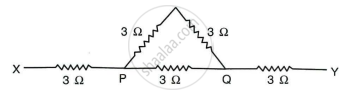
Five resistors, each 3 Ω, are connected as shown in Fig. Calculate the resistance
- between the points P and Q.
- between the points X and Y.
What is the equivalent resistance of 5 equal resistors, each of value 2`Omega` 1 when oonnected in (a) Series ( b) ParaIleI?
Explain, why is the p.d. between the terminals of a storage battery less when it is supplying current than when it is on open circuit. A battery of e.m.f. 10 volts and internal resistance 2.5 ohms has two resistances of 50 ohms each connected to it. Calculate the power dissipated in each resistance
(a) When they are in series,
(b) When they are in parallel.
In each case calculate the power dissipated in the battery.
Two resistors when connected in parallel give the resultant resistance of 2 ohms, but when connected in series the effective resistance becomes 9 ohms. Calculate the value of each resistance.
The least resistance obtained by using 2 Ω, 4 Ω, 1 Ω and 100 Ω is:
