Advertisements
Advertisements
प्रश्न
Study the following circuit:

On the basis of this circuit, answer the following questions:
i. Find the value of total resistance between the points A and B.
ii. Find the resistance between the points B and C.
iii. Calculate the current drawn from the battery, when the key is closed
OR
iii. In the above circuit, the 16Ω resistor or the parallel combination of two resistors of 8 Ω, which one of the two will have more potential difference across its two ends? Justify your answer.
Advertisements
उत्तर
i. To find the total resistance between points A and B, we simply add up the resistances in series:
RAB = R4Ω + R6Ω + R16Ω = 4Ω + 6Ω + 16Ω = 26Ω
ii. The resistance between points B and C is a bit more complex because we have two resistances in parallel. We use the formula for resistances in parallel:
`1/R_(BC)=1/R_(8Ω,upper)+1/R_(8Ω,lower)`
`1/R_(BC)=1/(8Ω)+1/(8Ω)= 1/(4Ω)`
`R_(BC) = 4Ω`
iii. To calculate the current drawn from the battery when the key is closed, we need to find the total resistance in the circuit. The total resistance will be the sum of the resistance between A and B and the equivalent resistance between B and C which we found to be
RAB + RBC = 26Ω + 4Ω = 30Ω
Now, using Ohm's Law (V=IR), where V is the voltage of the battery, I is the current, and R is the total resistance, we can find the current:
`I = V/R = (6V)/(30Ω) = 0.2 A`
So, the current drawn from the battery is 0.2 A (or 200 mA).
OR
iii. The potential difference across a resistor in a circuit is given by Ohm's Law, which states:
V = I.R
where V is the potential difference, I is the current, and R is the resistance.
In the given circuit, the 16Ω resistor is in series with two other resistors (4Ω and 6Ω), and the combination of two 8Ω resistors is in parallel. The total resistance in series (4Ω + 6Ω + 16Ω = 26Ω) is greater than the effective resistance of the parallel combination of two 8Ω resistors which is 4Ω, since resistors in parallel have an effective resistance Rparallel given by
`1/R_("parallel")=1/R_1+1/R_2`
Therefore, the series combination (including the 16Ω resistor) has more resistance than the parallel combination, which means it will have more potential difference across it. Since the same current flows through the series resistors, the potential difference across the 16Ω resistor will be the largest among the individual resistors because it has the highest resistance.
So, the 16Ω resistor will have more potential difference across its ends than the parallel combination of two 8Ω resistors.
APPEARS IN
संबंधित प्रश्न
With a neat labelled diagram and derive the equation for three resistances connected in parallel.
A hot plate of an electric oven connected to a 220 V line has two resistance coils A and B, each of 24 Ω resistances, which may be used separately, in series, or in parallel. What are the currents in the three cases?
Explain with diagram what is meant by the "series combination" and "parallel combination" of resistances. In which case the resultant resistance is : (i) less, and (ii) more, than either of the individual resistances?
Two resistors, with resistance 5 Ω and 10 Ω respectively are to be connected to a battery of emf 6 V so as to obtain:
(i) minimum current flowing
(ii) maximum current flowing
(a) How will you connect the resistances in each case?
(b) Calculate the strength of the total current in the circuit in the two cases.
In the circuit given below:
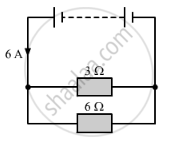
(a) What is the combined resistance?
(b) What is the p.d. across the combined resistor?
(c) What is the p.d. across the 3 Ω resistor?
(d) What is the current in the 3 Ω resistor?
(e) What is the current in the 6 Ω resistor?
In the diagram shown alongside, the cell and the ammeter both have negligible resistance. The resistors are identical.
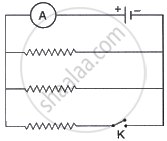
With the switch K open, the ammeter reads 0.6 A. What will be the ammeter reading when the switch is closed?
The figure given below shows three resistors?
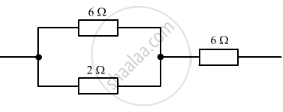
Their combined resistance is:
(a) `1 5/7`Ω
(b) `14` Ω
(c) `6 2/3` Ω
(d) `7 1/2` Ω
If current flows through two lamps arranged:
(a) in series,
(b) in parallel,
and the filament of one lamps breaks, what happens to the other lamp? Explain your answer.
Calculate the equivalent resistance between the points A and B in Fig. if each resistance is 2·0 Ω.

Assertion: When a battery is short circuited, the terminal voltage is zero.
Reason: In a short circuit, the current is zero.
