Advertisements
Advertisements
प्रश्न
Explain with the help of a labelled circuit diagram, how you will find the resistance of a combination of three resistors of resistances R1, R2 and R3 joined in parallel.
Advertisements
उत्तर

Let the resistance of the three resistors be R1, R2 and R3, respectively. Let their combined resistance be R. Let the total current flowing in the circuit be I and the strength of the battery be V. Then from Ohm's law, we have:
V = IR .....(1)
We know that when the resistors are connected in parallel, the potential drop across each resistance is the same.
Therefore:
I = I1 + I2 + I3
I = V/R1 + V/R2 + V/R3
I = V/(1/R1 + 1/R2 + 1/R3) ...... (2)
From equations (1) and (2) we have:
1/R = 1/R1 + 1/R2 + 1/R3
APPEARS IN
संबंधित प्रश्न
Complete the following :-
(c)

How can three resistors of resistances 2 Ω, 3 Ω and 6 Ω be connected to give a total resistance of 4 Ω ?
Several electric bulbs designed to be used on a 220 V electric supply line are rated 10 W. How many lamps can be connected in parallel with each other across the two wires of 220 V line if the maximum allowable current is 5 A?
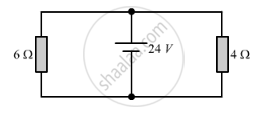
Find the current in each resistor in the circuit shown below:
A 4 Ω coil and a 2 Ω coil are connected in parallel. What is their combined resistance? A total current of 3 A passes through the coils. What current passes through the 2 Ω coil?
A wire of resistance R1 is cut into five equal pieces. These five pieces of wire are then connected in parallel. If the resultant resistance of this combination be R2, then the ratio `R_1/R_2` is:
(a) `1/25`
(b)1/5
(c)5
(c)25
Two exactly similar electric lamps are arranged (i) in parallel, and (ii) in series. If the parallel and series combination of lamps are connected to 220 V supply line one by one, what will be the ratio of electric power consumed by them?
Four resistors each of resistance 2Ω are connected in parallel. What is the effective resistance?
Calculate the equivalent resistance between the points A and B in Fig. if each resistance is 2·0 Ω.

Show how would you connect three resistors, each of resistance 6 O so that
the combination has a resistance of(a) 9 Ω (b) 4 .Ω
A particular resistance wire has a resistance of 3 ohm per meter. Find :
The total resistance of three lengths of this wire each 1.5 m long, in parallel.
How does the resistance of a metallic wire depend on the length of wire?
A given wire is stretched to double its length. How will its resistance change?
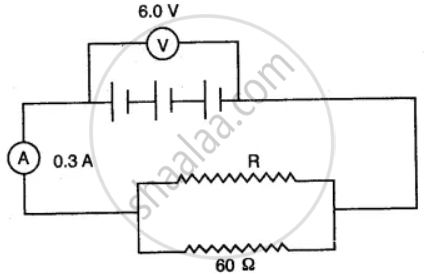
In the figure below, the ammeter A reads 0.3 A. Calculate:
(i) the total resistance of the circuit
(ii) the value of R
(iii) the current flowing through R.
What connection is used in domestic appliances and why?
Calculate the current flows through the 10 Ω resistor in the following circuit.

A coil in the heater consumes power P on passing current. If it is cut into halves and joined in parallel, it will consume power:
Three resistors of 1 Ω, 2 Ω and 3 Ω are connected in parallel. The combined resistance of the three resistors should be:
Three resistors of 6Ω, 4Ω and 4Ω are connected together so that the total resistance is 8Ω. Draw a diagram to show this arrangement and give reason to justify your answer.
