Advertisements
Advertisements
प्रश्न
Calculate the equivalent resistance between the points A and B in Fig. if each resistance is 2·0 Ω.

Advertisements
उत्तर
r1 = r2 = r3 = r4 = 2 Ω
Both r1 and r2 are connected in series in the figure.
Total resistance in series R1 = r1 + r2
= 2 + 2
= 4 Ω
r3 and r4 are in parallel `1/"R" = 1/r_1 + 1/r_2`
= `1/2 + 1/2 = 1`
R2 = 1 Ω
Total resistance R1 + R2 = 4 + 1 = 5 Ω
APPEARS IN
संबंधित प्रश्न
How can three resistors of resistances 2 Ω, 3 Ω and 6 Ω be connected to give a total resistance of 4 Ω ?
A resistor has a resistance of 176 ohms. How many of these resistors should be connected in parallel so that their combination draws a current of 5 amperes from a 220 volt supply line?
A 4 Ω coil and a 2 Ω coil are connected in parallel. What is their combined resistance? A total current of 3 A passes through the coils. What current passes through the 2 Ω coil?
In the diagram shown alongside, the cell and the ammeter both have negligible resistance. The resistors are identical.
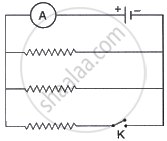
With the switch K open, the ammeter reads 0.6 A. What will be the ammeter reading when the switch is closed?
In parallel combination of resistances ______.
What are the advantages of a parallel connection?
Tick (✓) the correct choice among the following :
Consider two cases of two parallel current carrying conductors. Current in
th e same direction and currents in th e opposi te directions will produce
Three resistors of 1 Ω, 2 Ω and 3 Ω are connected in parallel. The combined resistance of the three resistors should be:
Three resistors of 6Ω, 4Ω and 4Ω are connected together so that the total resistance is 8Ω. Draw a diagram to show this arrangement and give reason to justify your answer.
A particular resistance wire has a resistance of 3·0 ohm per metre. Find the resistance of 5 m length of a wire of the same material, but with twice the area of cross section.
