Advertisements
Advertisements
प्रश्न
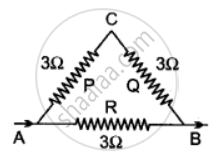
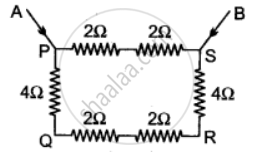
Calculate equivalent resistance in the following cases:
Advertisements
उत्तर
(i) Resistance P and Q are in series = 3 Ω + 3 Ω = 6 Ω
Resistance of 6 Ω segment and 3 Ω are parallel.
∴ `1/"R" = 1/6 + 1/3 = (1 + 2)/6 = 3/6` or R = 2Ω
(ii) Resistance of the arm PS = 2Ω +2Ω = 4Ω (in series)
Resistance of the arm QR = 2Ω + 2Ω = 4Ω (in series)
Resistance of the arm PQ, QR and RS are in series
= (4 + 4 + 4)Ω = 12Ω
Now resistance of the arm RS and arms (PQ + QR + RS) are in parallel.
`1/"R" = 1/4 + 1/12`
`= (3 + 1)/12 = 4/12`
or R = 3Ω
संबंधित प्रश्न
How many 176 Ω resistors (in parallel) are required to carry 5 A on a 220 V line?
Show how you would connect three resistors, each of resistance 6 Ω, so that the combination has a resistance of 9 Ω.
State the law of combination of resistances in parallel.
Two resistances when connected in parallel give resultant value of 2 ohm; when connected in series the value becomes 9 ohm. Calculate the value of each resistance.
You are given three resistances of 1, 2 and 3 ohms. Shows by diagrams, how with the help of these resistances you can get:
(i) 6 Ω
(ii) `6/1` Ω
(iii) 1.5 Ω
How will you connect three resistors of 2 Ω, 3 Ω and 5 Ω respectively so as to obtain a resultant of 2.5 Ω? Draw the diagram to show the arrangement.
How will you connect three resistors of resistances 2 Ω, 3 Ω, and 6 Ω to obtain a total resistance of 4 Ω, and 1 Ω?
Calculate the equivalent resistance between the points A and B in Fig. if each resistance is 2·0 Ω.

A uniform wire with a resistance of 27 Ω is divided into three equal pieces and then they are joined in parallel. Find the equivalent resistance of the parallel combination.
Two resistors of resistances 2 Ω and 3 Ω are connected in parallel to a cell to draw current 0.5 A from the cell. Draw a labelled diagram of the arrangement
