Advertisements
Advertisements
Question
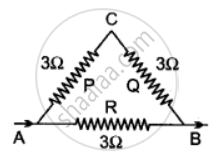
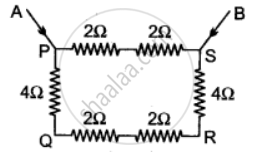
Calculate equivalent resistance in the following cases:
Advertisements
Solution
(i) Resistance P and Q are in series = 3 Ω + 3 Ω = 6 Ω
Resistance of 6 Ω segment and 3 Ω are parallel.
∴ `1/"R" = 1/6 + 1/3 = (1 + 2)/6 = 3/6` or R = 2Ω
(ii) Resistance of the arm PS = 2Ω +2Ω = 4Ω (in series)
Resistance of the arm QR = 2Ω + 2Ω = 4Ω (in series)
Resistance of the arm PQ, QR and RS are in series
= (4 + 4 + 4)Ω = 12Ω
Now resistance of the arm RS and arms (PQ + QR + RS) are in parallel.
`1/"R" = 1/4 + 1/12`
`= (3 + 1)/12 = 4/12`
or R = 3Ω
RELATED QUESTIONS
Differentiate between resistances in series and parallel.
What are the advantages of connecting electrical devices in parallel with the battery instead of connecting them in series?
Show how would you join three resistors, each of resistance 9 Ω so that the equivalent resistance of the combination is
1) 13.5
2) 6 Ω
A resistor has a resistance of 176 ohms. How many of these resistors should be connected in parallel so that their combination draws a current of 5 amperes from a 220 volt supply line?
Show how would you connect three resistors, each of resistance 6 O so that
the combination has a resistance of(a) 9 Ω (b) 4 .Ω
An electrical appliance having a resistance of 200 Ω is operated at 200 V. Calculate the energy consumed by the appliance in 5 minutes in kWh.
Solve the following question:
In an electric circuit, two resistors of 12 0 each are joined in parallel to a 6 V battery. Find the current drawn from the battery.
Calculate the current flows through the 10 Ω resistor in the following circuit.


The diagram above is a schematic diagram of a household circuit. The house shown in the above diagram has 5 usable spaces where electrical connections are made. For this house, the mains have a voltage of 220 V and the net current coming from the mains is 22A.
- What is the mode of connection to all the spaces in the house from the mains?
- The spaces 5 and 4 have the same resistance and spaces 3 and 2 have respective resistances of 20Ω and 30Ω. Space 1 has a resistance double that of space 5. What is the net resistance for space 5.
- What is the current in space 3?
- What should be placed between the main connection and the rest of the house’s electrical appliances to save them from accidental high electric current?
You have three resistors of values 2 Ω, 3 Ω, and 5 Ω. How will you join them so that the total resistance is less than 1 Ω? Draw a diagram and find the total resistance.
