Advertisements
Advertisements
Question
A battery of e.m.f. 15 V and internal resistance 2 `Omega` is connected to tvvo resistors of 4 ohm and 6 ohm joined.
(i) In series,
(ii) In para 1 lel. Find in each case the electrica I energy spent per minute in 6 ohm resistor.
Advertisements
Solution
Given, emf= 15 V, internal resistance, r= 2 `Omega`
(i) Total resistance of given resistors in series, Rs = 4 + 6 = 10 `Omega`
Now, current through series combination on, Is = `"emf"/("R"_"s" + "r") = 15/(10 + 2) = 15/12` = 1.25 A
In series, the same current will pass through each resistor
.·. electrical energy spent per minute in the 6`Omega` resistor, Hs = I2 (R) t = (1.25)2 (6) (60) = 562.5 J
(ii) Total resistance of given resistors in parallel, RP = `(1/4 + 1/6) ^-1 = 2.4 Omega`
Current in parallel circuit, I = `15/(2.4 + 20) = 3.4 "A"`
In parallel, each resistor is connected across the same voltage, say V.
Then, V = e - Ir= 15 - (3.4 x 2) = 8.18 volt
:. electrical energy spent per minute in the 6Ω resistor, Hp = `"V"^2/"R" t = (8.18)^2/6 xx 60 `= 669.1 J
APPEARS IN
RELATED QUESTIONS
Two resistors, with resistance 5 Ω and 10 Ω respectively are to be connected to a battery of emf 6 V so as to obtain:
(i) minimum current flowing
(ii) maximum current flowing
(a) How will you connect the resistances in each case?
(b) Calculate the strength of the total current in the circuit in the two cases.
Two resistances when connected in parallel give resultant value of 2 ohm; when connected in series the value becomes 9 ohm. Calculate the value of each resistance.
A resistor of 8 ohms is connected in parallel with another resistor X. The resultant resistance of the combination is 4.8 ohms. What is the value of the resistor X?
How will you connect three resistors of resistances 2 Ω, 3 Ω, and 6 Ω to obtain a total resistance of 4 Ω, and 1 Ω?
Are the lights in your house wired in series?
Two exactly similar electric lamps are arranged (i) in parallel, and (ii) in series. If the parallel and series combination of lamps are connected to 220 V supply line one by one, what will be the ratio of electric power consumed by them?
You have three resistors of values 2Ω, 3Ω and 5Ω. How will you join them so that the total resistance is less than 1Ω? Draw diagram and find the total resistance.
A current of 2 A is passed through a coil of resistance 75 Ω for 2 minutes.
(a) How much heat energy is produced?
(b) How much charge is passed through the resistance?
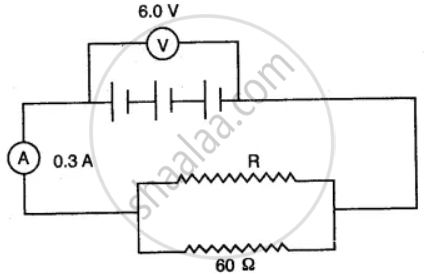
In the figure below, the ammeter A reads 0.3 A. Calculate:
(i) the total resistance of the circuit
(ii) the value of R
(iii) the current flowing through R.
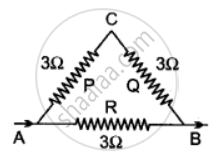
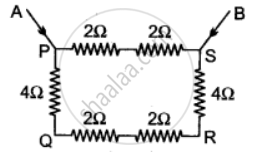
Calculate equivalent resistance in the following cases: