Advertisements
Advertisements
Question
Two resistors, with resistance 5 Ω and 10 Ω respectively are to be connected to a battery of emf 6 V so as to obtain:
(i) minimum current flowing
(ii) maximum current flowing
(a) How will you connect the resistances in each case?
(b) Calculate the strength of the total current in the circuit in the two cases.
Advertisements
Solution
a) For the minimum current flowing in the circuit, the resistors should be connected in series and for the maximum current in the circuit, the resistors should be connected in parallel with the battery.
(b) When the resistors are connected in parallel:
Resistance in parallrl arrangement is given
`1/R=1/R_1+1/R_2`
Here `R_1=5`Ω
`R_2=10`Ω
`1/R=1/5+1/10`
`or1/R=(10+5)/50`
`or1/R=15//50`
`R=50/15=3.33`Ω
Total resistance = 3.33 Ω
Therefore, strength of the total current, I = V / R
I = 6 / 3.33
I = 1.8 A
When the resistors are connected in series, the resultant resistance is given by R = R1 + R2
Here, R1 = 5 Ω
R2= 10 Ω
So, R = 5Ω+ 10Ω = 15 Ω
Total resistance = 15 Ω
Therefore, strength of the total current, I = 6 / 15 = 0.4 A
APPEARS IN
RELATED QUESTIONS
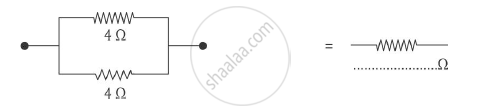
Complete the following :-
(b)
Show how would you join three resistors, each of resistance 9 Ω so that the equivalent resistance of the combination is
1) 13.5
2) 6 Ω
State the law of combination of resistances in parallel.
State how are the two resistors joined with a battery when potential difference is same across each resistor.
In parallel combination of resistances ______.
What are the advantages of a parallel connection?
Two resistors of resistance 4 Ω and 6 Ω are connected in parallel to a cell to draw 0.5 A current from the cell.
Draw a labeled diagram of the arrangement
A particular resistance wire has a resistance of 3 ohm per meter. Find the potential difference of the battery which gives a current of 2 A in each of the 1.5 m length when connected in the parallel to the battery (assume that resistance of the battery is negligible).
Solve the following question:
In an electric circuit, two resistors of 12 0 each are joined in parallel to a 6 V battery. Find the current drawn from the battery.
How does the resistance of a metallic wire depend on the length of wire?
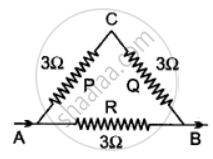
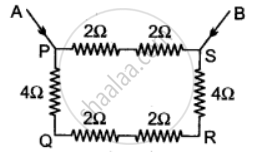
Calculate equivalent resistance in the following cases:
A piece of wire having a resistance R is cut into five equal parts.
- How will the resistance of each part of the wire change compared with the original resistance?
- If the five parts of the wire are placed in parallel, how will the resistance of the combination change?
- What will be ratio of the effective resistance in series connection to that of the parallel connection?
Two resistors when connected in parallel give the resultant resistance of 2 ohms, but when connected in series the effective resistance becomes 9 ohms. Calculate the value of each resistance.
Three resistors of 6Ω, 4Ω and 4Ω are connected together so that the total resistance is 8Ω. Draw a diagram to show this arrangement and give reason to justify your answer.
Two V-I graphs A and B for series and parallel combinations of two resistors are as shown. Giving reason state which graph shows (a) series, (b) parallel combination of the resistors.

Study the following circuit:

On the basis of this circuit, answer the following questions:
i. Find the value of total resistance between the points A and B.
ii. Find the resistance between the points B and C.
iii. Calculate the current drawn from the battery, when the key is closed
OR
iii. In the above circuit, the 16Ω resistor or the parallel combination of two resistors of 8 Ω, which one of the two will have more potential difference across its two ends? Justify your answer.
You have three resistors of values 2 Ω, 3 Ω, and 5 Ω. How will you join them so that the total resistance is less than 1 Ω? Draw a diagram and find the total resistance.
