Advertisements
Advertisements
Question
The circuit diagram given below shows the combination of three resistors R1, R2 and R3:
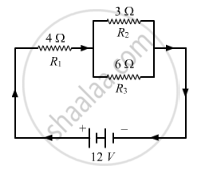
Find :
(i) total resistance of the circuit.
(ii) total current flowing in the circuit.
(iii) the potential difference across R1.
Advertisements
Solution
(i) As shown in the figure, the resistors R2 and R3 are connected in parallel. Their total resistance is given by:
1/R = 1/R2+ 1/R3
Here, R2 = 3 Ω
R3 = 6 Ω
So,
1/R = 1/3 + 1/6
Or 1/R = (2+1)/6
1/R = 3/6
R = 2 Ω
This resistance is in series with the resistor, R1.
Total resistance = 2 Ω + R1
R1 = 4 Ω
Therefore, total resistance = 2 Ω + 4 Ω = 6 Ω
(ii) The current through the circuit can be calculated as follows:
Current, I = V / R
I = (12 / 6) A
I = 2 A
(iii) The potential difference across R1 = 2 A x 4 Ω = 8 V
APPEARS IN
RELATED QUESTIONS
Define the unit of current.
In 10 s, a charge of 25 C leaves a battery, and 200 J of energy are delivered to an outside circuit as a result.
- What is the p.d. across the battery?
- What current flows from the battery?
If the amount of electric charge passing through a conductor in 10 minutes is 300 C, the current flowing is:
(a) 30 A
(b) 0.3 A
(c) 0.5 A
(d) 5 A
Two resistors of 4 Ω and 6 Ω are connected in parallel. The combination is
connected across a 6 volt battery of negligible resistance. Calculate:
( i) The power supplied by the battery,
(ii) The power dissipated in each resistor.
Electrical appliances have voltage and power ratings as listed below. Which
has the larger working resistance?
| Appliances | Voltage (V) | Power (W) |
| (a) Washing machine | 250 | 3000 |
| ( b) Television | 240 | 160 |
| (c)240 | 240 | 1500 |
| ( d) Hair curler | 250 | 20 |
| ( e) Car head lamp | 12 | 36 |
Define the term kilowatt - hour and state its value in S.I. unit.
1 kWh = `(1 "volt" xx 1 "ampere" xx "_________")/1000`
State the condition when it is advantageous to connect cells in parallel.
The power of an electric device is a product of ______ and ______.
One unit of electrical energy consumed is equal to 1000 kilowatt-hour.
What are the effects of electric current?
By convention, the direction of electric current in the external circuit is taken as:
In electrolytes such as salt solutions, the charge carriers are:
The RMS value of AC is defined as:
