Advertisements
Advertisements
प्रश्न
The circuit diagram given below shows the combination of three resistors R1, R2 and R3:
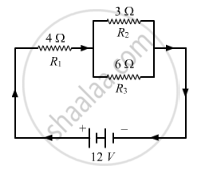
Find :
(i) total resistance of the circuit.
(ii) total current flowing in the circuit.
(iii) the potential difference across R1.
Advertisements
उत्तर
(i) As shown in the figure, the resistors R2 and R3 are connected in parallel. Their total resistance is given by:
1/R = 1/R2+ 1/R3
Here, R2 = 3 Ω
R3 = 6 Ω
So,
1/R = 1/3 + 1/6
Or 1/R = (2+1)/6
1/R = 3/6
R = 2 Ω
This resistance is in series with the resistor, R1.
Total resistance = 2 Ω + R1
R1 = 4 Ω
Therefore, total resistance = 2 Ω + 4 Ω = 6 Ω
(ii) The current through the circuit can be calculated as follows:
Current, I = V / R
I = (12 / 6) A
I = 2 A
(iii) The potential difference across R1 = 2 A x 4 Ω = 8 V
APPEARS IN
संबंधित प्रश्न
Draw the electrical symbols of the following components and state its use:
Ammeter.
How many milliamperes as there in 1 ampere?
Why should the resistance of:
a voltmeter be very large?
Which instrument is used to measure electric current? How should it be connected in a circuit?
Which statement/statement is/are correct?
1. An ammeter is connected in series in a circuit and a voltmeter is connected in parallel.
2. An ammeter has a high resistance.
3. A voltmeter has a low resistance.
(a) 1, 2, 3
(b) 1, 2
(c) 2, 3
(d) 1
An electric bulb of resistance 20 Ω and a resistance wire of 4 Ω are connected in series with a 6 V battery.
Draw the circuit diagram, and calculate:
(a) total resistance of the circuit.
(b) current through the circuit.
(c) potential difference across the electric bulb.
(d) potential difference across the resistance wire.
A 5 V battery is connected to two 20 Ω resistors which are joined together in series.
(a) Draw a circuit diagram to represent this. Add an arrow to indicate the direction of conventional current flow in the circuit.
(b) What is the effective resistance of the two resistors?
(c) Calculate the current that flows from the battery?
(d) What is the p.d. across each resistor?
The rating of a fuse connected in the lighting circuit is ______.
Calculate the amount of energy transferred by a 10 A electric current flowing through a resistor of 5 o for 15 minutes.
Define the following:
Semiconductors
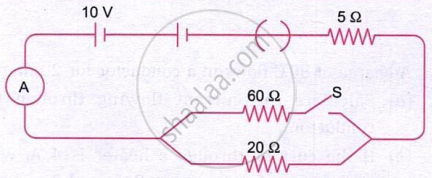
In the circuit shown in fig., find the reading of the ammeter A when the switch S is opened.
A wire is passed through a piece of cardboard as shown in fig .. An electric current flows vertically down the wire and then flows back up. The two sections of the write are observed to repel each other.
(a) Wi th the aid of a diagram, describe how you would plot the magnetic field lines on the card .
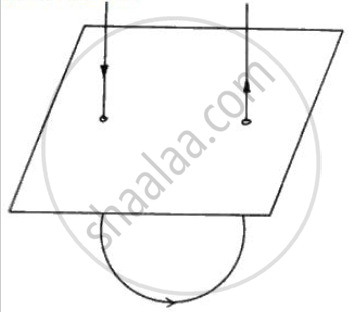
(b) Sketch the magnetic field patterns around both the sections of the wire. Use your sketch to explain why the two sections repel each other.
(c) The repulsive force between the two sections is small. What changes could be made to increase it?
Electrical power P is given by the expression P = (Q × V) ÷ time
(a) What do the symbols Q and V represent?
(b) Express the power P in terms of current and resistance explaining the meanings of symbols used there in.
My mother was operating washing machine on Sunday morning. Suddenly, she saw a spark coming out of the electric board and the electric current in the house failed. An electrician was called to look into the matter. What should he have noticed.
Name any two devices, which are working on the heating effect of the electric current.
The number of electrons constituting a 1-coulomb charge is ______.
The direction of Direct Current (DC) is characterized as:
