Advertisements
Advertisements
प्रश्न
In the circuit shown below, the voltmeter reads 10 V.
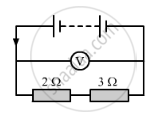
(a) What is the combined resistance?
(b) What current flows?
(c) What is the p.d. across 2 Ω resistor?
(d) What is the p.d. across 3 Ω resistor?
Advertisements
उत्तर
(a) The resistors of 2 Ω and 3 Ω are connected in series.
Therefore their combined resistance, R = R1 + R2
Here, R1=2 Ω
R2=3 Ω
So, the combined resistance, R = 2 Ω + 3 Ω
R = 5 Ω
(b) The current, I in the circuit can be calculated as:
V = IR
or I = 10 / 5 = 2 At)=R2R1+R2v(t)
(c) The p.d. across the 2 Ω resistor is:
V = IR
or V = `2xx2` = 4 V
(d) The p.d. across the 3 Ω resistor:
V = IR
or V = 2 x 3
or V = 6 V
APPEARS IN
संबंधित प्रश्न
How many microamperes are there in 1 ampere?
An electric circuit consisting of a 0.5 m long nichrome wire XY, an ammeter, a voltmeter, four cells of 1.5 V each and a plug key was set up.
(i) Draw a diagram of this electric circuit to study the relation between the potential difference maintained between the points 'X' and 'Y' and the electric current flowing through XY.
An electric circuit consisting of a 0.5 m long nichrome wire XY, an ammeter, a voltmeter, four cells of 1.5 V each and a plug key was set up.
Following graph was plotted between V and I values:
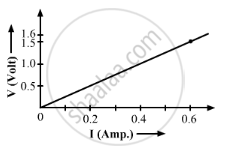
What would be the values of `V/I` rations when the potential difference is 0.8 V, 1.2 V and 1.6 V respectively?
What conclusion do you draw from these values?
What is the resistance of the wire?
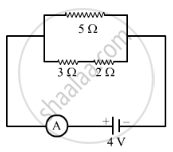
(a) With the help of a circuit diagram, obtain the relation for the equivalent resistance of two resistances connected in parallel.
(b) In the circuit diagram shown below, find:
(i) Total resistance.
(ii) Current shown by the ammeter A
Ten bulbs are connected in a series circuit to a power supply line. Ten identical bulbs are connected in a parallel circuit to an identical power supply line.
- Which circuit would have the highest voltage across each bulb?
- In which circuit would the bulbs be brighter?
- In which circuit, if one bulb blows out, all others will stop glowing?
- Which circuit would have less current in it?
A given wire of resistance 1 Ω is stretched to double its length. What will be its new resistance?
Complete the following sentence:
Fuse wire has a ............ Melting point and it is made of an alloy of ......... and if the current in a circuit rises too high, the fuse wire ...........
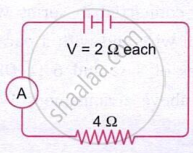
Two cells each having an e.m.f. of 2 V and an internal resistance of \(2,\Omega\) are connected in series as shown in Fig. What is the current flowing through the circuit in each case?
In a house there are 6 bulbs of 100 W each used for 4 hours a day, 4 bulbs of 60 W each used for 8 hours a day, an immersion heater of 2.5 kW used for 1 hour per day, and an electric iron of 800 W used for 2 hours per day. Calculate the cost of monthly electric bill for the month of April at the rate of 80 p per unit.
State the condition when it is advantageous to connect cells in parallel.
How should the electric lamps in a building be connected?
State the conditions for the flow of charge in a circuit from one point to the other.
Three resistances, of which two are equal when connected in series have an effective resistance of 30 ohms. When the three resistances are connected in parallel, the effective resistances is 3 ohms. Find the values of the individual resistances.
What is the speed of electric current?
Give the electric current unit.
Which of the following is the example expression for Alternating Current?
