Advertisements
Advertisements
Question
In the circuit shown below, the voltmeter reads 10 V.
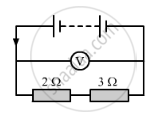
(a) What is the combined resistance?
(b) What current flows?
(c) What is the p.d. across 2 Ω resistor?
(d) What is the p.d. across 3 Ω resistor?
Advertisements
Solution
(a) The resistors of 2 Ω and 3 Ω are connected in series.
Therefore their combined resistance, R = R1 + R2
Here, R1=2 Ω
R2=3 Ω
So, the combined resistance, R = 2 Ω + 3 Ω
R = 5 Ω
(b) The current, I in the circuit can be calculated as:
V = IR
or I = 10 / 5 = 2 At)=R2R1+R2v(t)
(c) The p.d. across the 2 Ω resistor is:
V = IR
or V = `2xx2` = 4 V
(d) The p.d. across the 3 Ω resistor:
V = IR
or V = 2 x 3
or V = 6 V
APPEARS IN
RELATED QUESTIONS
The SI unit of charge is volt.
Why are metals good conductors of electricity whereas glass is a bad conductor of electricity? Give reason?
In which direction do electrons flow?
In 10 s, a charge of 25 C leaves a battery, and 200 J of energy are delivered to an outside circuit as a result.
- What is the p.d. across the battery?
- What current flows from the battery?
A battery of 9 V is connected in series with resistors of 0.2 Ω, 0.3 Ω, 0.4 Ω, 0.5 Ω and 12 Ω. How much current would flow through the 12 Ω resistor?
The circuit diagram given below shows the combination of three resistors R1, R2 and R3:
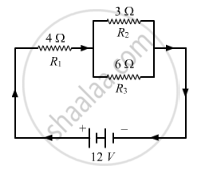
Find :
(i) total resistance of the circuit.
(ii) total current flowing in the circuit.
(iii) the potential difference across R1.
Draw a circuit diagram to show how two 4 V electric lamps can be lit brightly from two 2 V cells.
An auto lamp is joined to a battery of e.m.f. 4 V and internal resistance 2.5Ω. A steady current of 0.5 A flows through the circuit. Calculate the
(a) Total energy provided by battery in 10 minutes,
(b) Heat dissipated in the bulb in 10 minutes.
State the S.I. units of electrical power.
A bulb marked 12 V, 24 W operates on a 12 V battery for 20 minutes. Calculate:
- The current flowing through it, and
- The energy consumed.
Three heaters each rated 250 W, 100 V are connected in parallel to a 100 V supply. The resistance of each heater
An electric kettle is rated 2.5 kW, 250 V. Find the cost of running the kettle for two hours at Rs. 5.40 per unit.
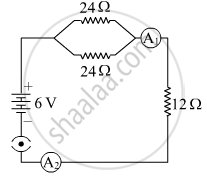
Study the following circuit and find out:
(i) Current in 12 Ω resistor.
(ii) The difference in the readings of A1 and A2, if any.
State the condition when it is advantageous to connect cells in series.
Unit of electric power may also be expressed as
Assertion (A): Electric current will not flow between two charged bodies when connected if their charges are the same.
Reason (R): Current is the rate of flow of charge.
By convention, the direction of electric current in the external circuit is taken as:
In electrolytes such as salt solutions, the charge carriers are:
