Advertisements
Advertisements
प्रश्न
In the circuit shown below, the voltmeter reads 10 V.
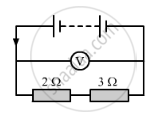
(a) What is the combined resistance?
(b) What current flows?
(c) What is the p.d. across 2 Ω resistor?
(d) What is the p.d. across 3 Ω resistor?
Advertisements
उत्तर
(a) The resistors of 2 Ω and 3 Ω are connected in series.
Therefore their combined resistance, R = R1 + R2
Here, R1=2 Ω
R2=3 Ω
So, the combined resistance, R = 2 Ω + 3 Ω
R = 5 Ω
(b) The current, I in the circuit can be calculated as:
V = IR
or I = 10 / 5 = 2 At)=R2R1+R2v(t)
(c) The p.d. across the 2 Ω resistor is:
V = IR
or V = `2xx2` = 4 V
(d) The p.d. across the 3 Ω resistor:
V = IR
or V = 2 x 3
or V = 6 V
APPEARS IN
संबंधित प्रश्न
If 20 C of charge pass a point in a circuit in 1 s, what current is flowing?
What happens to the other bulbs in a series circuit if one bulb blows off?
Christmas tree lamps are usually wired in series. What happens if one lamps breaks?
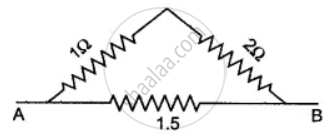
Calculate the effective resistance between the points A and B in the network shown below in Figure 8.45
Distinguish between an open and a closed circuit.
An electric current flowing in a wire creates ______ around the wire.
A 720 W heater operates from a 220 V line voltage. Calculate:
(a) The electrical energy consumed by the heater in 3 h.
(b) The cost of electrical energy consumption at the rate of 60 paise per kWh.
Complete the following sentence:
A fuse is connected in ........... with the ......... wire.
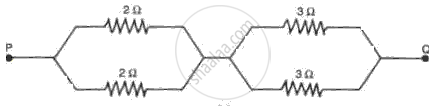
Find the effective resistance in the following circuit diagrams (Fig.):
If a fuse contains a 5 A fuse wire and the voltage is 240 V, what is the maximum power (wattage) which may be taken from the circuit?
60 joules of heat was dissipated in a resistor when 20 C flowed for 5 s. Calculate:
(a) P.d. across the resistor,
(b) Resistance of the resistor, and
(c) Average power dissipated in the resistor.
A bulb is connected to a battery of p.d. 4 V and internal resistance 2.5 Ω . A steady current of 0.5 A flows through the circuit. Calculate:
The energy dissipated in the bulb in 10 minutes.
Answer the following question.
An electric lamp of resistance 20 Ω and a conductor of resistance 4 0 are connected to a 6 V battery as shown in the circuit. Calculate: 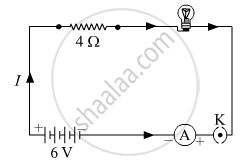
(a) the total resistance of the circuit,
(b) the current through the circuit,
(c) the potential difference across the (i) electric lamp and (ii) conductor, and
(d) power of the lamp.
At the time of short circuit, the electric current in the circuit ______.
Match the items in column-I to the items in column-II:
| Column - I | Column - II | ||
| (i) | electric current | (a) | volt |
| (ii) | potential difference | (b) | ohm meter |
| (iii) | specific resistance | (c) | watt |
| (iv) | electrical power | (d) | joule |
| (v) | electrical energy | (e) | ampere |
A charge of 20 C flows through a conductor in 4 s. The electric current through the conductor is:
