Advertisements
Advertisements
Question
In the circuit given below:
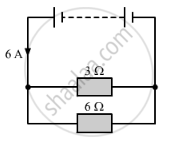
(a) What is the combined resistance?
(b) What is the p.d. across the combined resistor?
(c) What is the p.d. across the 3 Ω resistor?
(d) What is the current in the 3 Ω resistor?
(e) What is the current in the 6 Ω resistor?
Advertisements
Solution
(a) The resistors of 6 Ω and 3 Ω are connected in parallel. Therefore, their combined resistance can be calculated as:
1/R = 1/R1 + 1/R2
Here, R1 = 6 Ω ,
R2 = 3 Ω
1/R = (1/6) + (1/3 )
1/R = (1 + 2)/6
R = 6/3
R = 2 Ω
(b) Potential difference, V = IR
The potential difference across the combined resistance,
V = `(6xx2)` V
V = 12 V
(c) The potential difference across the 3 Ω resistor can be calculated as:
V = IR
V =`6xx3`= 18 V
(d) The current across the 3 Ω resistor is:
I = V/R
I = 12/3
I = 4 A
(e) The current across the 6 Ω resistor is:
I = V/R
I = 12/6
I = 2 A
APPEARS IN
RELATED QUESTIONS
With a neat labelled diagram and derive the equation for three resistances connected in parallel.
How can three resistors of resistances 2 Ω, 3 Ω and 6 Ω be connected to give a total resistance of 4 Ω ?
How many 176 Ω resistors (in parallel) are required to carry 5 A on a 220 V line?
Explain with the help of a labelled circuit diagram, how you will find the resistance of a combination of three resistors of resistances R1, R2 and R3 joined in parallel.
Are the lights in your house wired in series?
If current flows through two lamps arranged:
(a) in series,
(b) in parallel,
and the filament of one lamps breaks, what happens to the other lamp? Explain your answer.
State how are the two resistors joined with a battery when equivalent resistance is less than either of the two resistances.
Two resistors having resistance 4𝛀 and 6𝛀 are connected in parallel. Find their equivalent resistance.
You have three resistors of values 2Ω, 3Ω and 5Ω. How will you join them so that the total resistance is less than 1Ω? Draw diagram and find the total resistance.
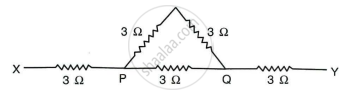
Five resistors, each 3 Ω, are connected as shown in Fig. Calculate the resistance
- between the points P and Q.
- between the points X and Y.
A particular resistance wire has a resistance of 3 ohm per meter. Find the total resistance of three lengths of this wire each 1.5 m long, joined in parallel.
A battery of e.m.f 16 V and internal resistance 2 Ω is connected to two resistors 3Ω and 6Ω connected in parallel. Find:
- the current through the battery.
- p.d. between the terminals of the battery,
- the current in 3 Ω resistors,
- the current in 6 Ω resistor.
Show how would you connect three resistors, each of resistance 6 O so that
the combination has a resistance of(a) 9 Ω (b) 4 .Ω
Explain, why is the p.d. between the terminals of a storage battery less when it is supplying current than when it is on open circuit. A battery of e.m.f. 10 volts and internal resistance 2.5 ohms has two resistances of 50 ohms each connected to it. Calculate the power dissipated in each resistance
(a) When they are in series,
(b) When they are in parallel.
In each case calculate the power dissipated in the battery.
The circuit diagram Fig shows three resistors 2 Ω, 4 Ω and R Ω connected to a battery of e.m.f. 2 V and internal resistance 3 Ω. If main current of 0.25 A flows through the circuit, find:
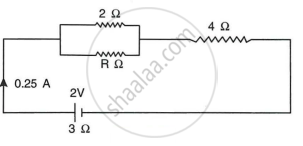
- the p.d. across the 4 Ω resistor,
- the p.d. across the internal resistance of the cell,
- the p.d. across the R Ω or 2 Ω resistors
- the value of R.
How does the resistance of a metallic wire depend on the thickness of wire?
Two devices are connected between two points say A and B in parallel. The physical quantity that will remain the same between the two points is:
Calculate the current flows through the 10 Ω resistor in the following circuit.

Two resistors of resistance 2 Ω and 3 Ω are connected in parallel to a cell to draw current 0.5 A from the cell. Calculate the current in each resistor.
A particular resistance wire has a resistance of 3·0 ohm per metre. Find the resistance of 5 m length of a wire of the same material, but with twice the area of cross section.
