Advertisements
Advertisements
Question
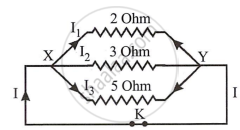
You have three resistors of values 2 Ω, 3 Ω, and 5 Ω. How will you join them so that the total resistance is less than 1 Ω? Draw a diagram and find the total resistance.
Advertisements
Solution
It is necessary to connect the resistors in parallel because we desire an effective resistance that is lower than the minimum value of the individual resistors.
∴ `1/"R" = 1/"R"_1 + 1/"R"_2 + 1/"R"_3`
`1/"R" = 1/2 + 1/3 +1/5`
= `(15 + 10 + 6)/30`
= `31/30`
∴ R = `30/31 < 1Ω`
R = 0.97 Ω
APPEARS IN
RELATED QUESTIONS
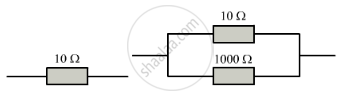
Which of the following arrangement, A or B, has the lower combined resistance?
Explain with the help of a labelled circuit diagram, how you will find the resistance of a combination of three resistors of resistances R1, R2 and R3 joined in parallel.
In the diagram shown alongside, the cell and the ammeter both have negligible resistance. The resistors are identical.
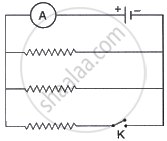
With the switch K open, the ammeter reads 0.6 A. What will be the ammeter reading when the switch is closed?
The figure given below shows three resistors?
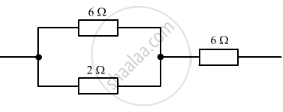
Their combined resistance is:
(a) `1 5/7`Ω
(b) `14` Ω
(c) `6 2/3` Ω
(d) `7 1/2` Ω
Show with the help of diagrams, how you would connect three resistors each of resistance 6 Ω, so that the combination has resistance of (i) 9 Ω (ii) 4 Ω.
The least resistance obtained by using 2 Ω, 4 Ω, 1 Ω and 100 Ω is:
A coil in the heater consumes power P on passing current. If it is cut into halves and joined in parallel, it will consume power:
A piece of wire of resistance R is cut into three equal parts. These parts are then connected in parallel. If the equivalent resistance of this parallel combination is R1, what is the value of the ratio R1 : R?
Two resistors of resistance 2 Ω and 3 Ω are connected in parallel to a cell to draw current 0.5 A from the cell. Calculate the current in each resistor.
