Advertisements
Advertisements
प्रश्न
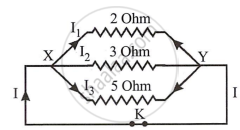
You have three resistors of values 2 Ω, 3 Ω, and 5 Ω. How will you join them so that the total resistance is less than 1 Ω? Draw a diagram and find the total resistance.
Advertisements
उत्तर
It is necessary to connect the resistors in parallel because we desire an effective resistance that is lower than the minimum value of the individual resistors.
∴ `1/"R" = 1/"R"_1 + 1/"R"_2 + 1/"R"_3`
`1/"R" = 1/2 + 1/3 +1/5`
= `(15 + 10 + 6)/30`
= `31/30`
∴ R = `30/31 < 1Ω`
R = 0.97 Ω
APPEARS IN
संबंधित प्रश्न
Show how you would connect three resistors, each of resistance 6 Ω, so that the combination has a resistance of 9 Ω.
Two resistances when connected in parallel give resultant value of 2 ohm; when connected in series the value becomes 9 ohm. Calculate the value of each resistance.
State how are the two resistors joined with a battery when equivalent resistance is less than either of the two resistances.
A particular resistance wire has a resistance of 3 ohm per meter. Find the total resistance of three lengths of this wire each 1.5 m long, joined in parallel.
A battery of e.m.f. 15 V and internal resistance 2 `Omega` is connected to two resistors of 4 ohm and 6 ohm joined.
(i) In series,
(ii) In parallel.
Find in each case the electrical energy spent per minute in 6 ohm resistor.
Show how would you connect three resistors, each of resistance 6 O so that
the combination has a resistance of(a) 9 Ω (b) 4 .Ω
An electrical appliance having a resistance of 200 Ω is operated at 200 V. Calculate the energy consumed by the appliance in 5 minutes in kWh.
Three resistors of 1 Ω, 2 Ω and 3 Ω are connected in parallel. The combined resistance of the three resistors should be:
Assertion: When a battery is short circuited, the terminal voltage is zero.
Reason: In a short circuit, the current is zero.
Two resistors of resistance 2 Ω and 3 Ω are connected in parallel to a cell to draw current 0.5 A from the cell. Calculate the current in each resistor.
