Advertisements
Advertisements
प्रश्न
Two resistances when connected in parallel give resultant value of 2 ohm; when connected in series the value becomes 9 ohm. Calculate the value of each resistance.
Advertisements
उत्तर
Let the resistances of the two resistors be x and y.
When they are connected in parallel, we have:
1 / x + 1 / y = 1 / 2 ... (1)
When they are connected in series, we have:
x + y = 9 ... (2)
On solving equations (1) and (2), we will obtain the values of the two resistors as 3 Ω and 6 Ω.
APPEARS IN
संबंधित प्रश्न
Show how would you join three resistors, each of resistance 9 Ω so that the equivalent resistance of the combination is
1) 13.5
2) 6 Ω
Two resistors, with resistance 5 Ω and 10 Ω respectively are to be connected to a battery of emf 6 V so as to obtain:
(i) minimum current flowing
(ii) maximum current flowing
(a) How will you connect the resistances in each case?
(b) Calculate the strength of the total current in the circuit in the two cases.
An electric heater which is connected to a 220 V supply line has two resistance coils A and B of 24 Ω resistance each. These coils can be used separately (one at a time), in series or in parallel. Calculate the current drawn when:
(a) only one coil A is used.
(b) coils A and B are used in series.
(c) coils A and B are uses in parallel.
A 4 Ω coil and a 2 Ω coil are connected in parallel. What is their combined resistance? A total current of 3 A passes through the coils. What current passes through the 2 Ω coil?
A resistor of 8 ohms is connected in parallel with another resistor X. The resultant resistance of the combination is 4.8 ohms. What is the value of the resistor X?
How will you connect three resistors of 2 Ω, 3 Ω and 5 Ω respectively so as to obtain a resultant of 2.5 Ω? Draw the diagram to show the arrangement.
In parallel combination of resistances ______.
Which of the following combinations have the same equivalent resistance between X and Y?
Calculate the equivalent resistance between the points A and B in Fig. if each resistance is 2·0 Ω.

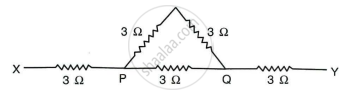
Five resistors, each 3 Ω, are connected as shown in Fig. Calculate the resistance
- between the points P and Q.
- between the points X and Y.
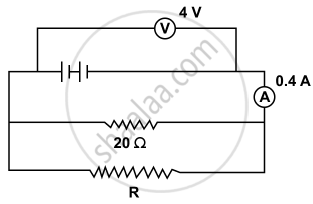
In the following figure calculate:
- the total resistance of the circuit
- the value of R, and
- the current flowing in R.
Explain, why is the p.d. between the terminals of a storage battery less when it is supplying current than when it is on open circuit. A battery of e.m.f. 10 volts and internal resistance 2.5 ohms has two resistances of 50 ohms each connected to it. Calculate the power dissipated in each resistance
(a) When they are in series,
(b) When they are in parallel.
In each case calculate the power dissipated in the battery.
Tick (✓) the correct choice among the following :
Consider two cases of two parallel current carrying conductors. Current in
th e same direction and currents in th e opposi te directions will produce
A particular resistance wire has a resistance of 3 ohm per meter. Find the potential difference of the battery which gives a current of 2 A in each of the 1.5 m length when connected in the parallel to the battery (assume that resistance of the battery is negligible).
A particular resistance wire has a resistance of 3 ohm per meter. Find :
The total resistance of three lengths of this wire each 1.5 m long, in parallel.
An electrical appliance has a rating 100 W, 120V. The resistance of element of appliance when in use:
The equivalent resistance of a parallel combination of two resistors of 30 Ω and 60 Ω is ______________.
What connection is used in domestic appliances and why?
Calculate the current flows through the 10 Ω resistor in the following circuit.

Two resistors having resistance 8 Ω and 12 Ω are connected in parallel. Find their equivalent resistance.
