Advertisements
Advertisements
प्रश्न
You have three resistors of values 2Ω, 3Ω and 5Ω. How will you join them so that the total resistance is less than 1Ω? Draw diagram and find the total resistance.
Advertisements
उत्तर
The three resistors should be connected in parallel
To get a total resistance less than 1Ω
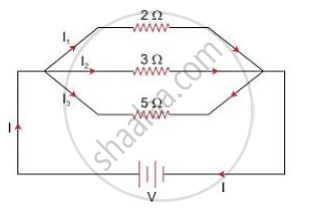
In parallel, if the equivalent resistance is RP, then
`therefore 1/R_p = 1/R_1 + 1/R_2 + 1/R_3`
`therefore 1/R_p =1/2+1/3+1/5`
`therefore 1/R_p = (15+10+6)/30`
`therefore 1/R_p = 31/30`
⇒ `R_p = 30/31 = 0.97 Ω`
संबंधित प्रश्न
In the diagram shown alongside, the cell and the ammeter both have negligible resistance. The resistors are identical.
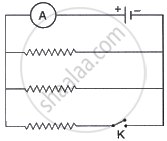
With the switch K open, the ammeter reads 0.6 A. What will be the ammeter reading when the switch is closed?
Two resistances when connected in parallel give resultant value of 2 ohm; when connected in series the value becomes 9 ohm. Calculate the value of each resistance.
Two resistors of resistance 4 Ω and 6 Ω are connected in parallel to a cell to draw 0.5 A current from the cell.
Calculate current in each resistor.
State the S.I. unit of electrical resistance and define it.
Two resistors when connected in parallel give the resultant resistance of 2 ohms, but when connected in series the effective resistance becomes 9 ohms. Calculate the value of each resistance.
Calculate the current flows through the 10 Ω resistor in the following circuit.


The diagram above is a schematic diagram of a household circuit. The house shown in the above diagram has 5 usable spaces where electrical connections are made. For this house, the mains have a voltage of 220 V and the net current coming from the mains is 22A.
- What is the mode of connection to all the spaces in the house from the mains?
- The spaces 5 and 4 have the same resistance and spaces 3 and 2 have respective resistances of 20Ω and 30Ω. Space 1 has a resistance double that of space 5. What is the net resistance for space 5.
- What is the current in space 3?
- What should be placed between the main connection and the rest of the house’s electrical appliances to save them from accidental high electric current?
Two resistors having resistance 8 Ω and 12 Ω are connected in parallel. Find their equivalent resistance.
Four resistors each of resistance 5 Ω are connected in parallel. What is the effective resistance?
