Advertisements
Advertisements
प्रश्न
Two resistors when connected in parallel give the resultant resistance of 2 ohms, but when connected in series the effective resistance becomes 9 ohms. Calculate the value of each resistance.
Advertisements
उत्तर
Resultant resistance of parallel combination RP = 2 Ω
Resultant resistance of series combination RS = 9 Ω
`1/"R"_p` = `1/"R"_1`+`1/"R"_2`
`1/2` = `1/"R"_1`+`1/"R"_2`
`1/2` = `("R"_1+"R"_2)/("R"_1"R"_2)`
2(R1 + R2) = R1R2 ….. (1)
RS = R1 + R2
⇒ 9 = R1 + R2
⇒ R1 = 9 – R2 ….. (2)
Substitute equation (2) in equation (1)
2(9 – R2 + R2) = (9 – R2) R2
⇒ \(18=9 \mathrm{R}_{2}-\mathrm{R}_{2}^{2}\)
⇒ \(\mathrm{R}_{2}^{2}-9 \mathrm{R}_{2}+18=0\)
⇒ (R2 – 3) (R2 – 6) = 0
⇒ R2 = 3, 6
(i) If R2 = 3; R1 = 9 – R2 = 9 – 3 = 6 Ω
(ii) If R2 = 6; R1 = 9 – R2 = 9 – 6 = 3 Ω.
APPEARS IN
संबंधित प्रश्न
What are the advantages of connecting electrical devices in parallel with the battery instead of connecting them in series?
How can three resistors of resistances 2 Ω, 3 Ω and 6 Ω be connected to give a total resistance of 4 Ω ?
Show how you would connect three resistors, each of resistance 6 Ω, so that the combination has a resistance of 9 Ω.
Show how would you join three resistors, each of resistance 9 Ω so that the equivalent resistance of the combination is
1) 13.5
2) 6 Ω
Show how you would connect two 4 ohm resistors to produce a combined resistance of (a) 2 ohms (b) 8 ohms.
A wire that has resistance R is cut into two equal pieces. The two parts are joined in parallel. What is the resistance of the combination?
Show with the help of diagrams, how you would connect three resistors each of resistance 6 Ω, so that the combination has resistance of (i) 9 Ω (ii) 4 Ω.
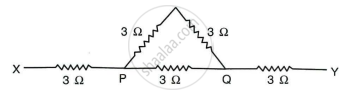
Five resistors, each 3 Ω, are connected as shown in Fig. Calculate the resistance
- between the points P and Q.
- between the points X and Y.
Explain, why is the p.d. between the terminals of a storage battery less when it is supplying current than when it is on open circuit. A battery of e.m.f. 10 volts and internal resistance 2.5 ohms has two resistances of 50 ohms each connected to it. Calculate the power dissipated in each resistance
(a) When they are in series,
(b) When they are in parallel.
In each case calculate the power dissipated in the battery.
The equivalent resistance of a parallel combination of two resistors of 30 Ω and 60 Ω is ______________.
