Advertisements
Advertisements
प्रश्न
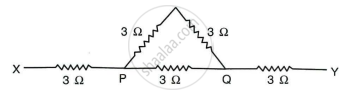
Five resistors, each 3 Ω, are connected as shown in Fig. Calculate the resistance
- between the points P and Q.
- between the points X and Y.
Advertisements
उत्तर
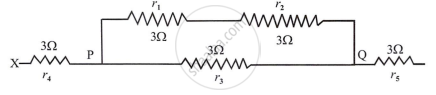
r1 and r2 are in series
∴ R1 = r1 + r2
= 3 + 3
= 6 Ω
Now R1 and r3 are in parallel
∴ `1/"R"_"p" = 1/"R"_1 + 1/"R"_3`
= `1/6 + 1/3`
= `(1 + 2)/6`
= `1/2`
- Resistance between P and Q = Rp = 2 Ω
- Resistance between X and Y r4, Rp and r5 are in series
∴ R = r4 + Rp + r5
R = 3 + 2 + 3
= 8 Ω
APPEARS IN
संबंधित प्रश्न
An electric lamp of 100 Ω, a toaster of resistance 50 Ω, and a water filter of resistance 500 Ω are connected in parallel to a 220 V source. What is the resistance of an electric iron connected to the same source that takes as much current as all three appliances, and what is the current through it?
Show how you would connect two 4 ohm resistors to produce a combined resistance of (a) 2 ohms (b) 8 ohms.
You are given three resistances of 1, 2 and 3 ohms. Shows by diagrams, how with the help of these resistances you can get:
(i) 6 Ω
(ii) `6/1` Ω
(iii) 1.5 Ω
If current flows through two lamps arranged:
(a) in series,
(b) in parallel,
and the filament of one lamps breaks, what happens to the other lamp? Explain your answer.
A particular resistance wire has a resistance of 3 ohm per meter. Find the total resistance of three lengths of this wire each 1.5 m long, joined in parallel.
An electrical appliance having a resistance of 200 Ω is operated at 200 V. Calculate the energy consumed by the appliance in 5 minutes in kWh.
How does the resistance of a metallic wire depend on the thickness of wire?
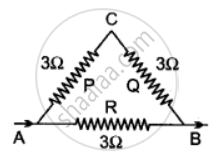
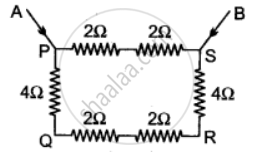
Calculate equivalent resistance in the following cases:
Two resistors having resistance 8 Ω and 12 Ω are connected in parallel. Find their equivalent resistance.
A particular resistance wire has a resistance of 3·0 ohm per metre. Find the resistance of 5 m length of a wire of the same material, but with twice the area of cross section.
