Advertisements
Advertisements
प्रश्न
A particular resistance wire has a resistance of 3·0 ohm per metre. Find the resistance of 5 m length of a wire of the same material, but with twice the area of cross section.
Advertisements
उत्तर
R = `ρ l/a` ...(i)
∵ the wire's substance is the same, ρ will stay the same
l1 = 5l and l = 1m, a1 = 2a
∴ R1 = ρ `l_1/a_1`
or R1 = ρ `(5l)/(2a)` ...(ii)
(ii) ÷ (i)
`"R"_1/"R" = (ρ(5l)/(2a))/(ρ(l)/(a)`
= `5/2`
R1 = `5/2 "R"`
= `5/2 xx (3.0)`
= 7.5 Ω
APPEARS IN
संबंधित प्रश्न
How can three resistors of resistances 2 Ω, 3 Ω and 6 Ω be connected to give a total resistance of 4 Ω ?
The equivalent resistance of the parallel combination of two resistors of 60Ω and 40Ω is _______.
A) 24Ω
(B) 100Ω
(C) 50 Ω
(D) 240Ω
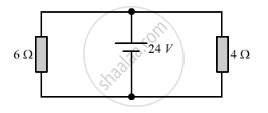
Find the current in each resistor in the circuit shown below:
In the circuit given below:
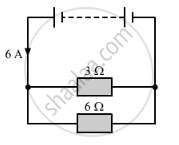
(a) What is the combined resistance?
(b) What is the p.d. across the combined resistor?
(c) What is the p.d. across the 3 Ω resistor?
(d) What is the current in the 3 Ω resistor?
(e) What is the current in the 6 Ω resistor?
If current flows through two lamps arranged:
(a) in series,
(b) in parallel,
and the filament of one lamps breaks, what happens to the other lamp? Explain your answer.
Two exactly similar electric lamps are arranged (i) in parallel, and (ii) in series. If the parallel and series combination of lamps are connected to 220 V supply line one by one, what will be the ratio of electric power consumed by them?
Four resistors each of resistance 2Ω are connected in parallel. What is the effective resistance?
What are the advantages of a parallel connection?
Two resistors of resistance 4 Ω and 6 Ω are connected in parallel to a cell to draw 0.5 A current from the cell.
Calculate current in each resistor.
Assertion: When a battery is short circuited, the terminal voltage is zero.
Reason: In a short circuit, the current is zero.
