Advertisements
Advertisements
Question
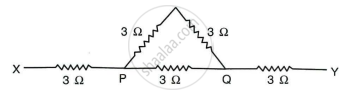
Five resistors, each 3 Ω, are connected as shown in Fig. Calculate the resistance
- between the points P and Q.
- between the points X and Y.
Advertisements
Solution
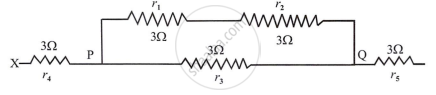
r1 and r2 are in series
∴ R1 = r1 + r2
= 3 + 3
= 6 Ω
Now R1 and r3 are in parallel
∴ `1/"R"_"p" = 1/"R"_1 + 1/"R"_3`
= `1/6 + 1/3`
= `(1 + 2)/6`
= `1/2`
- Resistance between P and Q = Rp = 2 Ω
- Resistance between X and Y r4, Rp and r5 are in series
∴ R = r4 + Rp + r5
R = 3 + 2 + 3
= 8 Ω
APPEARS IN
RELATED QUESTIONS
With a neat labelled diagram and derive the equation for three resistances connected in parallel.
How can three resistors of resistances 2 Ω, 3 Ω and 6 Ω be connected to give a total resistance of 4 Ω ?
A hot plate of an electric oven connected to a 220 V line has two resistance coils A and B, each of 24 Ω resistances, which may be used separately, in series, or in parallel. What are the currents in the three cases?
A 4 Ω coil and a 2 Ω coil are connected in parallel. What is their combined resistance? A total current of 3 A passes through the coils. What current passes through the 2 Ω coil?
How will you connect three resistors of 2 Ω, 3 Ω and 5 Ω respectively so as to obtain a resultant of 2.5 Ω? Draw the diagram to show the arrangement.
Tick (✓) the correct choice among the following :
Consider two cases of two parallel current carrying conductors. Current in
th e same direction and currents in th e opposi te directions will produce
A particular resistance wire has a resistance of 3 ohm per meter. Find the potential difference of the battery which gives a current of 2 A in each of the 1.5 m length when connected in the parallel to the battery (assume that resistance of the battery is negligible).
A current of 2 A is passed through a coil of resistance 75 Ω for 2 minutes.
(a) How much heat energy is produced?
(b) How much charge is passed through the resistance?
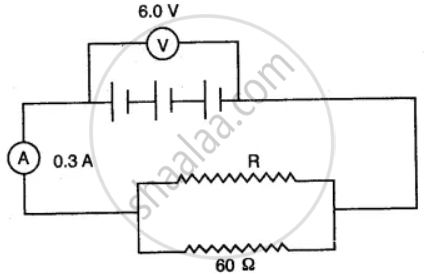
In the figure below, the ammeter A reads 0.3 A. Calculate:
(i) the total resistance of the circuit
(ii) the value of R
(iii) the current flowing through R.
Two devices are connected between two points say A and B in parallel. The physical quantity that will remain the same between the two points is:
