Advertisements
Advertisements
Question
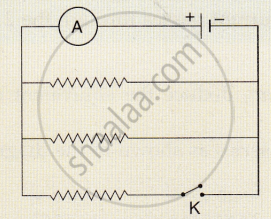
In the diagram shown below, the cell and the ammeter both have negligible resistance. The resistor are identical.
Advertisements
Solution
Let V be the voltage of the cell and R is the resistance of each resistor. When switch K is not closed then
\[\frac{V}{\frac{R}{2}} = 0 . 6 . . . . . (1) [\text{ Using V = I }R]\]
\[\text{ Let A be the current, when switch (K) is closed } \]
\[\frac{V}{\frac{R}{3}} = A . . . . . (2)\]
\[\text{ Dividing equation (2) by (1), we get }\]
\[\frac{A}{0 . 6} = 1 . 5\]
\[ A = 1 . 5 \times 0 . 6 = 0 . 9 A\]
APPEARS IN
RELATED QUESTIONS
Complete the following :-
(c)

How many 176 Ω resistors (in parallel) are required to carry 5 A on a 220 V line?
Show how would you join three resistors, each of resistance 9 Ω so that the equivalent resistance of the combination is
1) 13.5
2) 6 Ω
State the law of combination of resistances in parallel.
A resistor has a resistance of 176 ohms. How many of these resistors should be connected in parallel so that their combination draws a current of 5 amperes from a 220 volt supply line?
In the circuit given below:
(a) What is the combined resistance?
(b) What is the p.d. across the combined resistor?
(c) What is the p.d. across the 3 Ω resistor?
(d) What is the current in the 3 Ω resistor?
(e) What is the current in the 6 Ω resistor?
Explain with the help of a labelled circuit diagram, how you will find the resistance of a combination of three resistors of resistances R1, R2 and R3 joined in parallel.
Two resistances when connected in parallel give resultant value of 2 ohm; when connected in series the value becomes 9 ohm. Calculate the value of each resistance.
You are given three resistances of 1, 2 and 3 ohms. Shows by diagrams, how with the help of these resistances you can get:
(i) 6 Ω
(ii) `6/1` Ω
(iii) 1.5 Ω
State how are the two resistors joined with a battery when potential difference is same across each resistor.
Calculate the equivalent resistance between the points A and B in Fig. if each resistance is 2·0 Ω.

A battery of e.m.f 16 V and internal resistance 2 Ω is connected to two resistors 3Ω and 6Ω connected in parallel. Find:
- the current through the battery.
- p.d. between the terminals of the battery,
- the current in 3 Ω resistors,
- the current in 6 Ω resistor.
Two resistors of resistance 4 Ω and 6 Ω are connected in parallel to a cell to draw 0.5 A current from the cell.
Calculate current in each resistor.
An electrical appliance has a rating 100 W, 120V. The resistance of element of appliance when in use:
A current of 2 A is passed through a coil of resistance 75 Ω for 2 minutes.
(a) How much heat energy is produced?
(b) How much charge is passed through the resistance?
A piece of wire having a resistance R is cut into five equal parts.
- How will the resistance of each part of the wire change compared with the original resistance?
- If the five parts of the wire are placed in parallel, how will the resistance of the combination change?
- What will be ratio of the effective resistance in series connection to that of the parallel connection?
Three resistors of 1 Ω, 2 Ω and 3 Ω are connected in parallel. The combined resistance of the three resistors should be:
A particular resistance wire has a resistance of 3·0 ohm per metre. Find the resistance of 5 m length of a wire of the same material, but with twice the area of cross section.
