Advertisements
Advertisements
Question
If current flows through two lamps arranged:
(a) in series,
(b) in parallel,
and the filament of one lamps breaks, what happens to the other lamp? Explain your answer.
Advertisements
Solution
In a parallel circuit, if the filament of one lamp breaks, it will have no effect on the other lamp. If the same happens in a series circuit, the other lamp will stop glowing. This is because in a series circuit, if one of the bulbs blows off, the circuit is broken and the power supply to the other bulb is cut off.
APPEARS IN
RELATED QUESTIONS
What are the advantages of connecting electrical devices in parallel with the battery instead of connecting them in series?
Show how you would connect three resistors, each of resistance 6 Ω, so that the combination has a resistance of 9 Ω.
Show how would you join three resistors, each of resistance 9 Ω so that the equivalent resistance of the combination is
1) 13.5
2) 6 Ω
Which of the following arrangement, A or B, has the lower combined resistance?
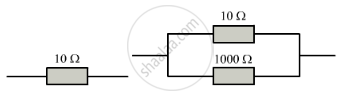
Explain with the help of a labelled circuit diagram, how you will find the resistance of a combination of three resistors of resistances R1, R2 and R3 joined in parallel.
You are given three resistances of 1, 2 and 3 ohms. Shows by diagrams, how with the help of these resistances you can get:
(i) 6 Ω
(ii) `6/1` Ω
(iii) 1.5 Ω
State how are the two resistors joined with a battery when equivalent resistance is less than either of the two resistances.
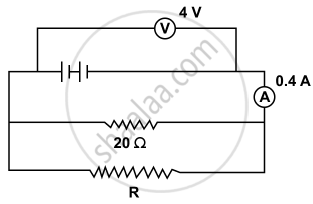
In the following figure calculate:
- the total resistance of the circuit
- the value of R, and
- the current flowing in R.
What are the advantages of a parallel connection?
An electrical appliance having a resistance of 200 Ω is operated at 200 V. Calculate the energy consumed by the appliance in 5 minutes in kWh.
The equivalent resistance of a parallel combination of two resistors of 30 Ω and 60 Ω is ______________.
Calculate the current flows through the 10 Ω resistor in the following circuit.

Assertion: When a battery is short circuited, the terminal voltage is zero.
Reason: In a short circuit, the current is zero.
You are given four ammeters A, B, C and D having the least counts mentioned below:
(I) Ammeter A with least count 0.25 A
(II) Ammeter B with least count 0.5 A
(III) Ammeter C with least count 0.05 A
(IV) Ammeter D with least count 0.1 A
Which of the ammeters would you prefer for doing an experiment to determine the equivalent resistance of two resistances most accurately, when connected in parallel?
Two V-I graphs A and B for series and parallel combinations of two resistors are as shown. Giving reason state which graph shows (a) series, (b) parallel combination of the resistors.

Study the following circuit:

On the basis of this circuit, answer the following questions:
i. Find the value of total resistance between the points A and B.
ii. Find the resistance between the points B and C.
iii. Calculate the current drawn from the battery, when the key is closed
OR
iii. In the above circuit, the 16Ω resistor or the parallel combination of two resistors of 8 Ω, which one of the two will have more potential difference across its two ends? Justify your answer.
You have three resistors of values 2 Ω, 3 Ω, and 5 Ω. How will you join them so that the total resistance is less than 1 Ω? Draw a diagram and find the total resistance.
