Advertisements
Advertisements
Question
How do you think the brightness of two lamps arranged in parallel compares with the brightness of two lamps arranged in series (both arrangements having one cell)?
Advertisements
Solution
The brightness of two lamps arranged in parallel will be more compared with the brightness of two lamps arranged in series because a parallel circuit offers less resistance.
APPEARS IN
RELATED QUESTIONS
Fill in the folloing blank with suitable words:
Current is measured in ............... using an ............... placed in ............... in a circuit.
In 10 s, charge of 25 C leaves a battery, and 200 J of energy are delivered to an outside circuit a result.
What current flows from the battery?
In the circuit shown below, the voltmeter reads 10 V.
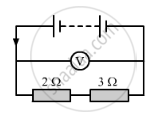
(a) What is the combined resistance?
(b) What current flows?
(c) What is the p.d. across 2 Ω resistor?
(d) What is the p.d. across 3 Ω resistor?
Ten bulbs are connected in a series circuit to a power supply line. Ten identical bulbs are connected in a parallel circuit to an identical power supply line.
- Which circuit would have the highest voltage across each bulb?
- In which circuit would the bulbs be brighter?
- In which circuit, if one bulb blows out, all others will stop glowing?
- Which circuit would have less current in it?
Which effect of current is utilised in an electric light bulb?
Define the term resistivity.
Two resistors of 2.0 Ω and 3.0 Ω are connected (a) in series (b) in parallel, with a battery of 6.0 V and negligible internal resistance. For each case draw a circuit diagram and calculate the current through the battery.
Define the following:
Super conductors
A bulb is connected to a battery of p.d. 4 V and internal resistance 2.5 Ω . A steady current of 0.5 A flows through the circuit. Calculate:
The resistance of the bulb
Answer the following question.
An electric lamp of resistance 20 Ω and a conductor of resistance 4 0 are connected to a 6 V battery as shown in the circuit. Calculate: 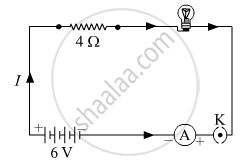
(a) the total resistance of the circuit,
(b) the current through the circuit,
(c) the potential difference across the (i) electric lamp and (ii) conductor, and
(d) power of the lamp.
State expression for Cells connected in series.
What is the speed of electric current?
Name any two devices, which are working on the heating effect of the electric current.
What are the effects of electric current?
Electric current is defined as:
The value used for practical measurement of Alternating Current is the:
