Advertisements
Advertisements
Question
A bulb is connected to a battery of p.d. 4 V and internal resistance 2.5 Ω . A steady current of 0.5 A flows through the circuit. Calculate:
The resistance of the bulb
Advertisements
Solution
Given ,
Voltage , V = 4 V
Resistance of the battery , RB = 2.5 Ω
Current , I = 0.5 A
Total resistance , R = 8 Ω
Resistance of the battery , RB = 2.5 Ω
Resistance of the blub, Rb = 8 - 2.5 Ω = 5.5 Ω
RELATED QUESTIONS
If the charge on an electron is 1.6 × 10⁻¹⁹ coulombs, how many electrons should pass through a conductor in 1 second to constitute 1 ampere current?
If the current passing through a conductor is doubled, what will be the change in heat produced
Which effect of current is utilised in the working of an electric fuse?
A cell supplies a current of 1.2 A through two 2 Ω resistors connected in parallel. When the resistors are connected in series, it supplies a current of 0.4 A. Calculate:
(i) the internal resistance and (ii) e.m.f. of the cell.
Two resistors of 4 Ω and 6 Ω are connected in parallel. The combination is
connected across a 6 volt battery of negligible resistance. Calculate:
( i) The power supplied by the battery,
(ii) The power dissipated in each resistor.
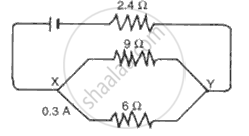
A current of 0.3 A is flowing through a branch of 6 Ω resistors in a junction as shown in fig. . Calculate the
(a) P.d. across the junction XY,
(b) Current flowing through 9Ω and 24Ω
( c) P.d. across 24 Ω resistor, and
( d) e.m.f. of the cell.
What is the SI unit for the current?
Electrons in a conductor move from:
