Advertisements
Advertisements
Question
Write down the formula which relates electric charge, time and electric current
Advertisements
Solution
If a charge of Q coulombs flows through a conductor in time t seconds, the magnitude, I of the electric current flowing through it is given by:
`I=Q/t`
APPEARS IN
RELATED QUESTIONS
Calculate the number of electrons constituting one coulomb of charge.
Three 2 V cells are connected in series and used as a battery in a circuit.
How many joules of electrical energy does 1 C gain on passing through (i) one cell (ii) all three cells?
In which direction do electrons flow?
In 10 s, a charge of 25 C leaves a battery, and 200 J of energy are delivered to an outside circuit as a result.
- What is the p.d. across the battery?
- What current flows from the battery?
In the circuit diagram given below, three resistors R1, R2, and R3 of 5 Ω, 10 Ω and 30 Ω, respectively are connected as shown
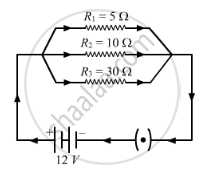
Calculate:
- current through each resistor.
- total current in the circuit.
- total resistance in the circuit.
Consider the circuit given below:
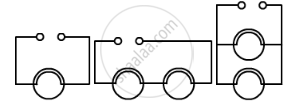
(a) In which circuit are the lamps dimmest?
(b) In which circuit or circuits are the lamps of equal brightness to the lamps in circuit (i)?
(c) Which circuit gives out the maximum light?
State two differences between the e.m.f. and terminal voltage of a cell.
Match the pairs.
| ‘A’ Group | ‘B’ Group |
| 1. Free electrons | a. V/R |
| 2. Current | b. Increases the resistance in the circuit |
| 3. Resistivity | c. Weakly attached |
| 4. Resistances in series | d. VA/LI |
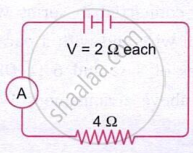
Two cells each having an e.m.f. of 2 V and an internal resistance of \(2,\Omega\) are connected in series as shown in Fig. What is the current flowing through the circuit in each case?
If a fuse contains a 5 A fuse wire and the voltage is 240 V, what is the maximum power (wattage) which may be taken from the circuit?
An electric oven is rated as 1.5 kW, 250 V. If it is connected to a 250 V mains, calculate the
(a) Current drawn,
(b) Energy consumed in 20 hours,
(c) Cost of energy consumed in 20 hours at the rate of Re. 1 per unit.
A bulb is connected to a battery of p.d. 4 V and internal resistance 2.5 Ω . A steady current of 0.5 A flows through the circuit. Calculate:
The resistance of the bulb
A bulb is connected to a battery of p.d. 4 V and internal resistance 2.5 Ω . A steady current of 0.5 A flows through the circuit. Calculate:
The energy dissipated in the bulb in 10 minutes.
Answer the following question.
What is the function of a galvanometer in a circuit?
State the conditions for the flow of charge in a circuit from one point to the other.
Problems for practice:
If 5A current flows through a circuit, then convert the current in terms of microampere?
What are the effects of electric current?
Define the following:
Conventional current
The direction of Direct Current (DC) is characterized as:
