Advertisements
Advertisements
Question
In the circuit diagram given below, three resistors R1, R2, and R3 of 5 Ω, 10 Ω and 30 Ω, respectively are connected as shown
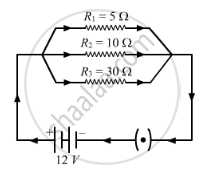
Calculate:
- current through each resistor.
- total current in the circuit.
- total resistance in the circuit.
Advertisements
Solution
a. Let I1, I2 and I3 be the current flowing through the resistors of 5 Ω, 10 Ω and 30 Ω, respectively.
According to Ohm's law, V = IR
Here, V = 12 V and R = 5 Ω
`I = V/R`
`I_1 = 12/5 = 2.4 A`
`I_2 = 12/10 = 1.2 A`
`I_3 = 12/30 = 0.4 A`
b. Total current through the circuit, I = I1 + I2 + I3
= 2.4 A + 1.2 A + 0.4 A
= 4 A
c. The resistors of 5 Ω, 10 Ω and 30 Ω are connected in parallel. Therefore, the net resistance will be:
`1/ R = 1/R_1 + 1/R_2 + 1/R_3`
`1/R = (1/5) + (1/10) + (1/30)`
`1/R = (6 + 3 +1)/30`
`I/R = 10/30`
R = 3 Ω
APPEARS IN
RELATED QUESTIONS
In which direction do electrons flow?
Which of the two is connected in series : ammeter or voltmeter?
If 20 C of charge pass a point in a circuit in 1 s, what current is flowing?
What Makes an Electric Current Flow in a Wire?
Which unit could be used to measure current?
(a) Watt
(b) Coulomb
(c) Volt
(d) Ampere
Draw a circuit diagram showing two electric lamps connected in parallel together with a cell and a switch that works both lamps. Mark an â’¶ on your diagram to show where an ammeter should be placed to measure the current.
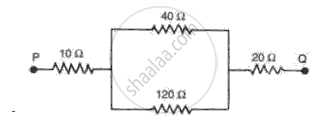
Find the effective resistance in the following circuit diagrams (Fig.):
The following appliances are to be used on 240 V supply. Calculate the current used by each and say which fuse, 2 amp, 5 amp or 13 amp should be incorporated with each, (i) A television rated at 150 W, (ii) An electric iron rated at 750 W, (iii) An immersion heater rated at 3000 W, (iv) A hair dryer rated at 500 W. How much will it cost to run the television set for 100 days for an average of 4 hours a day at 60 paise per unit?
A wire is passed through a piece of cardboard as shown in fig .. An electric current flows vertically down the wire and then flows back up. The two sections of the write are observed to repel each other.
(a) Wi th the aid of a diagram, describe how you would plot the magnetic field lines on the card .
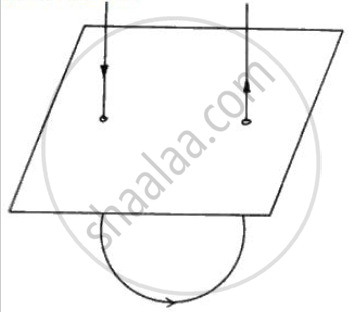
(b) Sketch the magnetic field patterns around both the sections of the wire. Use your sketch to explain why the two sections repel each other.
(c) The repulsive force between the two sections is small. What changes could be made to increase it?
State whether the current is a scalar or vector?
Two electric bulbs rated 100 W; 220 V and 60 W; 220 V are connected in parallel to electric mains of 220 V. Find the current drawn by the bulbs from the mains.
Explain, why the potential difference across the terminals of a cell is more when the cell is not in use than it is when the cell is being used.
Conventionally, the direction of the current is taken as:
Unit of electric power may also be expressed as
In ionised gases (plasma), the charge carriers are:
