Advertisements
Advertisements
Question
In the circuit diagram given below five resistances of 10 Ω, 40 Ω, 30 Ω, 20 Ω, and 60 Ω are connected as shown to a 12 V battery.
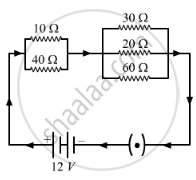
Calculate:
(a) total resistance in the circuit.
(b) total current flowing in the circuit.
Advertisements
Solution
(a) When three resistors are connected in parallel, the net resistance can be obtained as followed:
1/R = 1/R1 + 1/R2 + 1/R3
The resistors of 30 Ω, 20 Ω and 60 Ω are connected in parallel. Therefore, the net resistance R will be:
1/R = 1/30 + 1/20 +1/60
1/R = (2 + 3 + 1)/60
1/R = 6/60
R =10 Ω
Two more resistors of 10 Ω and 40 Ω are connected in parallel to each other. Therefore, their net resistance, R' will be:
1/R' = (1/10) + (1/40)
1/R' = (4 + 1)/40
1/R' = 5/40
R' = 8 Ω
The resistors of 8 Ω and 10 Ω are connected in series. Therefore, the net resistance of the circuit =R+R,=8 Ω + 10 Ω = 18 Ω
(b) The total current flowing through the circuit can be calculated as:
I = V/R
I = 12/18
I = 0.67 A
APPEARS IN
RELATED QUESTIONS
Why should the resistance of:
a voltmeter be very large?
Which statement/statement is/are correct?
1. An ammeter is connected in series in a circuit and a voltmeter is connected in parallel.
2. An ammeter has a high resistance.
3. A voltmeter has a low resistance.
(a) 1, 2, 3
(b) 1, 2
(c) 2, 3
(d) 1
A battery and three lamps are connected as shown:
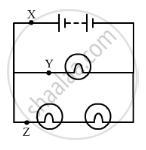
Which of the following statements about the currents at X, Y and Z is correct?
(a) The current at Z is greater than that at Y.
(b) The current at Y is greater than that at Z.
(c) The current at X equals the current at Y.
(d) The current at X equals the current at Z.
Two resistors P and Q of the same material and length but of different thickness are connected in parallel to a battery. The cross- sectional area of P is twice that of Q. What is the ratio of
(a) The resistance of P to the resistance of Q?
(b) The current in P to the current in Q?
Find the effective resistance in the following circuit diagrams (Fig.):
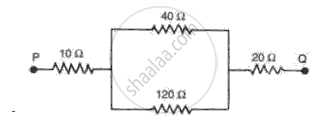
Fig. shows a 3 pin plug with the cover removed. The electric cable
connected to the plug contains 3 wires with colour coded insulation namely brown, blue and green.
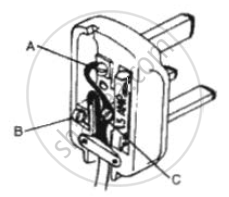
- Identify each of the colour coded wires by stating to which of the
terminals A, B or C in the diagram they should be connected. - Identify the terminal through which no current passes in normal
circumstances. - What is the purpose of the earthed wire connected to an electric
appliance like an electric heater? Describe how it works.
An auto lamp is joined to a battery of e.m.f. 4 V and internal resistance 2.5Ω. A steady current of 0.5 A flows through the circuit. Calculate the
(a) Total energy provided by battery in 10 minutes,
(b) Heat dissipated in the bulb in 10 minutes.
A strong short bar magnet is dropped into a solenoid connected to a
galvanometer as shown in fig. The galvanometer shows a deflection to the left when the current in the coil as seen from above is counter clockwise. Which one of the following shows the correct deflection of the galvanometer when the magnet is at posi tions A, Band C.
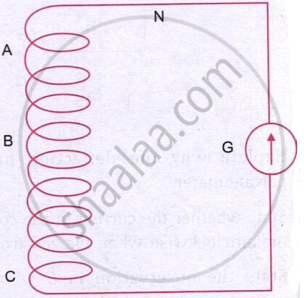
Tick (✓) the correct choice among the following :
Which of the following changes would enable a millimeter to be used as a
direct current ammeter reading upto 1 A?
Calculate the current through a 60 W lamp rated 250 V. If the line voltage falls to 200 V, how is power consumed by the bulb affected?
Three heaters each rated 250 W, 100 V are connected in parallel to a 100 V supply of the energy supplied in kWh to the three heaters in 5 hours.
- What is meant by electric current?
- Name and define its unit.
- Which instrument is used to measure the electric current? How should it be connected in a circuit?
Unit of electric power may also be expressed as
For current to flow, one needs art open circuit.
The value used for practical measurement of Alternating Current is the:
The number of electrons required to produce a total charge of 1.6 C is:
In the process of current flow through a conductor, the amount of charge passing per unit time gives:
