Advertisements
Advertisements
Question
State three factors on which the heat produced by an electric current depends. How does it depend on these factors?
Advertisements
Solution
The heat produced by an electric current depends on the square of the current, the resistance of the device and the time for which the current is passed through the device, i.e.:
H = I2Rt
APPEARS IN
RELATED QUESTIONS
Define the unit of current.
Three 2 V cells are connected in series and used as a battery in a circuit.
How many joules of electrical energy does 1 C gain on passing through (i) one cell (ii) all three cells?
Which is the better way to connect lights and other electrical appliances in domestic wiring: series circuits or parallel circuits? why?
Christmas tree lamps are usually wired in series. What happens if one lamps breaks?
In which of the following cases more electrical energy is consumed per hour?
(i) A current of 1 ampere passed through a resistance of 300 ohms.
(ii) A current of 2 amperes passed through a resistance of 100 ohms.
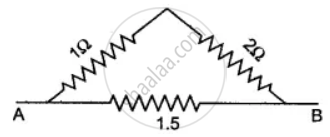
Calculate the effective resistance between the points A and B in the network shown below in Figure 8.45
A wire of length 5 m has a resistance of 2.0 Ω calculate:
(a) the resistance of wire of length 1 m
(b) the equivalent resistance if two such wires each of length 2 m are joined in parallel.
(c) the resistance of 1 m length of wire of same material but of half diameter.
If a charge of 420 C flows through a conducting wire in 5 minutes what is the value of the current?
Two resistors of 4 Ω and 6 Ω are connected in parallel. The combination is
connected across a 6 volt battery of negligible resistance. Calculate:
( i) The power supplied by the battery,
(ii) The power dissipated in each resistor.
Electrical power P is given by the expression P = (Q × V) ÷ time
(a) What do the symbols Q and V represent?
(b) Express the power P in terms of current and resistance explaining the meanings of symbols used there in.
At the time of short circuit, the electric current in the circuit ______.
Two electric bulbs rated 100 W; 220 V and 60 W; 220 V are connected in parallel to electric mains of 220 V. Find the current drawn by the bulbs from the mains.
What determines the direction of flow of electrons between two charged conductors kept in contact?
Which of the following represents voltage?
Unit of electric power may also be expressed as
A continuous and closed path of an electric current is called:
The number of electrons required to produce a total charge of 1.6 C is:
