Advertisements
Advertisements
Question
Advertisements
Solution
Watt-hour is the commercial unit of electrical energy.
One watt-hour is the electrical energy consumed by an electrical appliance of power 1 watt when it is used for 1 hour.
1Wh = 3600 J
APPEARS IN
RELATED QUESTIONS
The circuit diagram given below shows the combination of three resistors R1, R2 and R3:
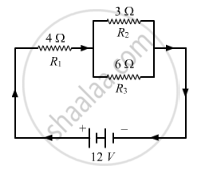
Find :
(i) total resistance of the circuit.
(ii) total current flowing in the circuit.
(iii) the potential difference across R1.
In the circuit diagram given below, three resistors R1, R2, and R3 of 5 Ω, 10 Ω and 30 Ω, respectively are connected as shown
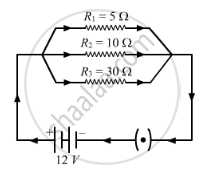
Calculate:
- current through each resistor.
- total current in the circuit.
- total resistance in the circuit.
(a) With the help of a circuit diagram, obtain the relation for the equivalent resistance of two resistances connected in parallel.
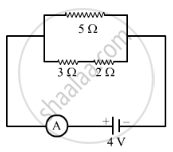
(b) In the circuit diagram shown below, find:
(i) Total resistance.
(ii) Current shown by the ammeter A
Electrical appliances have voltage and power ratings as listed below. Which
has the larger working resistance?
| Appliances | Voltage (V) | Power (W) |
| (a) Washing machine | 250 | 3000 |
| ( b) Television | 240 | 160 |
| (c)240 | 240 | 1500 |
| ( d) Hair curler | 250 | 20 |
| ( e) Car head lamp | 12 | 36 |
Three heaters each rated 250 W, 100 V are connected in parallel to a 100 V supply of the energy supplied in kWh to the three heaters in 5 hours.
A bulb is connected to a battery of p.d. 4 V and internal resistance 2.5 Ω . A steady current of 0.5 A flows through the circuit. Calculate:
The total energy supplied by the battery in 10 minutes
In current electricity, a positive charge refers to ______.
The relationship between conventional current and electron flow is that they are:
In a vacuum, the particles that can act as charge carriers are:
