Advertisements
Advertisements
Question
Find the potential difference required to pass a current of 0.2 A in a wire of resistance 20Ω
Advertisements
Solution
Current (I) = 0.2 A
Resistance (R) = 20 ohm
Potential Difference (V) = ?
According to Ohm's Law :
V = IR
V = 0.2 × 20 = 4 V
RELATED QUESTIONS
1 A = _________ mA
- 102
- 103
- 10-3
- 10-6
Which is the better way to connect lights and other electrical appliances in domestic wiring: series circuits or parallel circuits? why?
State three factors on which the heat produced by an electric current depends. How does it depend on these factors?
In the circuit shown in fig., find the reading of the ammeter A when the switch S is opened.
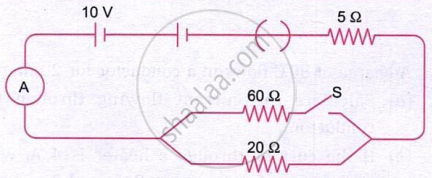
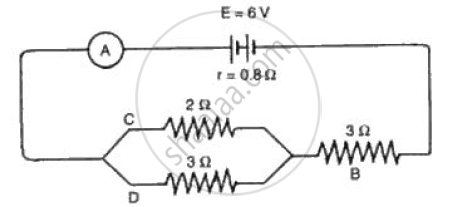
The circuit diagram (Fig.) shows a battery of e.m.f. 6 volts and internal
resistance of 0.8 Ω oonnected in series. Find the
(a) Current reoorded by the ammeter,
(b) P.d. across the terminals of the resistor B,
( c) Current passing through each of the resistors B, C and D, and
( d) P.d. across the terminals of the battery.
Which of the following correctly represents the formula for electric current?
Which of the following is the example expression for Alternating Current?
