Advertisements
Advertisements
प्रश्न
Find the potential difference required to pass a current of 0.2 A in a wire of resistance 20Ω
Advertisements
उत्तर
Current (I) = 0.2 A
Resistance (R) = 20 ohm
Potential Difference (V) = ?
According to Ohm's Law :
V = IR
V = 0.2 × 20 = 4 V
संबंधित प्रश्न
What is the Flow of Charge Called?
Draw a circuit diagram to show how two 4 V electric lamps can be lit brightly from two 2 V cells.
Define the following:
Electromotive force
What would be the danger involved in replacing a blown fuse with the one which would carry a large current?
A 3 pin mains plug is fitted to the lead for a 1 kW electric kettle to be used on a 250 V A.C. supply. Which of the following statements is NOT correct?
(a) A 13 A fuse is the most appropriate value to use.
(b) The brown wire should be connected to the live side of the mains.
Define the term kilowatt - hour and state its value in S.I. unit.
Answer the following question.
An electric lamp of resistance 20 Ω and a conductor of resistance 4 0 are connected to a 6 V battery as shown in the circuit. Calculate: 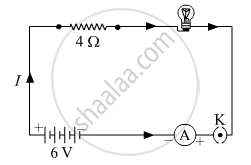
(a) the total resistance of the circuit,
(b) the current through the circuit,
(c) the potential difference across the (i) electric lamp and (ii) conductor, and
(d) power of the lamp.
The flow of electric charge per unit time is called potential difference.
Assertion (A): Electric current will not flow between two charged bodies when connected if their charges are the same.
Reason (R): Current is the rate of flow of charge.
The RMS value of AC is defined as:
