Advertisements
Advertisements
प्रश्न
Define the following:
Electromotive force
Define the emf of a cell.
Advertisements
उत्तर
Electromotive force: When no current is drawn from a cell, when the cell is in open circuit, the potential difference between the terminals of the cell is called its electromotive force (or e.m.f.).
APPEARS IN
संबंधित प्रश्न
How many microamperes are there in 1 ampere?
A battery and three lamps are connected as shown:
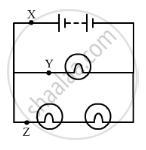
Which of the following statements about the currents at X, Y and Z is correct?
(a) The current at Z is greater than that at Y.
(b) The current at Y is greater than that at Z.
(c) The current at X equals the current at Y.
(d) The current at X equals the current at Z.
V1, V2 and V3 are the p.ds. across the 1Ω, 2Ω and 3Ω resistors in the following diagram, and the current is 5 A.
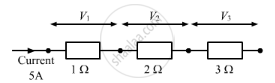
Which one of the columns (a) to (d) shows the correct values of V1, V2 and V3measured in volts?
`V_1` `V_2` `V_3`
(a) 1.0 2.0 3.0
(b) 5.0 10.0 15.0
(c) 5.0 2.5 1.6
(d) 4.0 4.0 2.0
Draw a circuit diagram showing two electric lamps connected in parallel together with a cell and a switch that works both lamps. Mark an â’¶ on your diagram to show where an ammeter should be placed to measure the current.
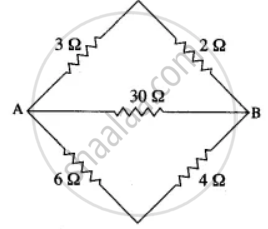
Calculate the equivalent resistance between A and B in the adjacent diagram.
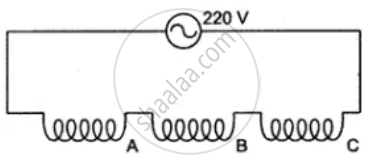
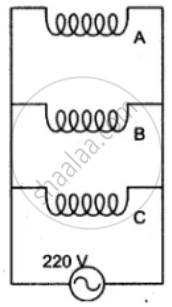
The diagram shows two ways of connecting three lamps P, Q and R to A.C. supply of 220 V.
The circuit diagram in fig shows two coils of an insulated copper wire wound on a cardboard tube. G is a center zero galvanometer.
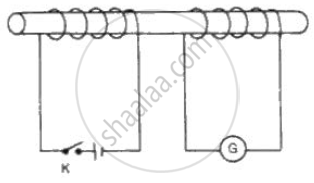
(a) Describe what will happen when th e swi tch K is cl osed for severa l
seconds and then opened again .
(b) What will be the effect of repeating the experiment with an iron placed in the tube?
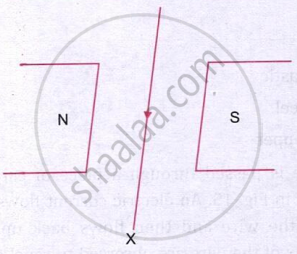
In fig. XY is at right angles to the magnetic field. The direction in which XY should be moved to induce an electron flow in the direction Y to X as indicated by the arrow is:
Electric current passes through a metallic conductor due to the movement of ______.
Match the items in column-I to the items in column-II:
| Column - I | Column - II |
| (i) electric current | (a) volt |
| (ii) potential difference | (b) ohm meter |
| (iii) specific resistance | (c) watt |
| (iv) Electrical power | (d) joule |
| (v) electrical energy | (e) ampere |
