Advertisements
Advertisements
प्रश्न
State two differences between the e.m.f. and terminal voltage of a cell.
State the differences between terminal voltage and emf.
Advertisements
उत्तर
| Sr. No. | e.m.f. of cell | Terminal voltage of cell |
| 1. | The amount of work required to move a unit positive charge in the entire circuit, both inside and outside the cell, serves as the measurement. | The amount of work required to move a unit of positive charge outside the cell serves as the measurement. |
| 2. | It is the characteristic of the cell, i.e., it does not depend on the amount of current drawn from the cell | It depends on the amount of current drawn from the cell. The more current drawn from the cell, the lower the terminal voltage. |
| 3. | It is equal to the terminal voltage when the cell is not in use and greater than the terminal voltage when the cell is in use. | It is equal to the cell's EMf when it is not in use, while it is less than the EMf when it is in use. |
संबंधित प्रश्न
Fill in the blank:
To increase the effective resistance in a circuit the resistors are connected in _____________.
A battery and three lamps are connected as shown:
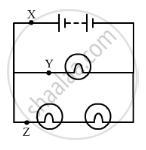
Which of the following statements about the currents at X, Y and Z is correct?
(a) The current at Z is greater than that at Y.
(b) The current at Y is greater than that at Z.
(c) The current at X equals the current at Y.
(d) The current at X equals the current at Z.
Which type of circuit, series or parallel, is preferred while connecting a large number of bulbs:
(b) for lighting inside the rooms of the hotel?
Draw a circuit diagram showing two electric lamps connected in parallel together with a cell and a switch that works both lamps. Mark an â’¶ on your diagram to show where an ammeter should be placed to measure the current.
How do you think the brightness of two lamps arranged in parallel compares with the brightness of two lamps arranged in series (both arrangements having one cell)?
The diagram shows two ways of connecting three lamps P, Q and R to A.C. supply of 220 V.
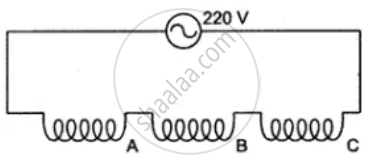
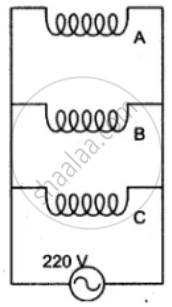
Tick (✓) the correct choice among the following :
There are 500 turns and 2000 turns in the primary and secondary coil of a
transformer respectively. If th e output voltage is 1000 V, how large is the
input voltage?
In semiconductors, the charge carriers are:
