Advertisements
Advertisements
प्रश्न
Advertisements
उत्तर
We know that,
P=VI
I = `"P"/"V" = (3 xx 1000)/250` = 12A
Thus, it can be used in a circuit which contains a 13A fuse.
APPEARS IN
संबंधित प्रश्न
One coulomb of charge flows through any cross-section of a conductor in 1 second. What is the current flowing through the conductor?
In the circuit shown below, the voltmeter reads 10 V.
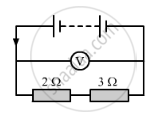
(a) What is the combined resistance?
(b) What current flows?
(c) What is the p.d. across 2 Ω resistor?
(d) What is the p.d. across 3 Ω resistor?
The figure given below shows an electric circuit in which current flows from a 6 V battery through two resistors.
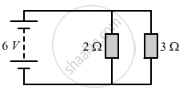
- Are the resistors connected in series with each other or in parallel?
- For each resistors, state the p.d. across it.
- The current flowing from the battery is shared between the two resistors. Which resistor will have bigger share of the current?
- Calculate the effective resistance of the two resistors.
- Calculate the current that flows from the battery.
Name two devices which work on the heating effect of electric current.
An electric oven is rated as 1.5 kW, 250 V. If it is connected to a 250 V mains, calculate the
(a) Current drawn,
(b) Energy consumed in 20 hours,
(c) Cost of energy consumed in 20 hours at the rate of Re. 1 per unit.
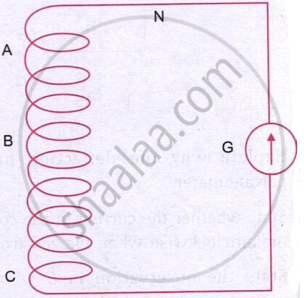
A strong short bar magnet is dropped into a solenoid connected to a
galvanometer as shown in fig. The galvanometer shows a deflection to the left when the current in the coil as seen from above is counter clockwise. Which one of the following shows the correct deflection of the galvanometer when the magnet is at posi tions A, Band C.
Three heaters each rated 250 W, 100 V are connected in parallel to a 100 V supply. The resistance of each heater
Coulomb is the SI unit of ____________.
