Topics
Electrostatics
Electric Charges and Fields
- Electric Charges
- Conductors and Insulators
- Properties of Electric Charge
- Coulomb’s Law
- Forces between Multiple Charges
- Electric Field
- Electric Field Due to a System of Charges
- Physical Significance of Electric Field
- Electric Field Lines
- Electric Flux
- Electric Dipole
- Dipole in a Uniform External Field
- Continuous Charge Distribution
- Gauss’s Law
- Application of Gauss' Law
Current Electricity
Electrostatic Potential and Capacitance
- Electric Potential and Potential Energy
- Electrostatic Potential
- Electric Potential Due to a Point Charge
- Potential Due to an Electric Dipole
- Potential due to a System of Charges
- Equipotential Surfaces
- Relation Between Electric Field and Electrostatic Potential
- Potential Energy of a System of Charges
- Potential Energy of a Single Charge
- Potential Energy of a System of Two Charges in an External Field
- Potential Energy of a Dipole in an External Field
- Electrostatics of Conductors
- Dielectrics and Polarisation
- Capacitors and Capacitance
- The Parallel Plate Capacitor
- Effect of Dielectric on Capacitance
- Combination of Capacitors
- Energy Stored in a Charged Capacitor
Magnetic Effects of Current and Magnetism
Current Electricity
- Electric Current
- Electric Currents in Conductors
- Ohm's Law
- Drift of Electrons and the Origin of Resistivity
- Mobility of Electrons
- Limitations of Ohm’s Law
- Resistivity of Various Materials
- Temperature Dependence of Resistivity
- Electrical Energy and Power in Conductors
- Cells, EMF, and Internal Resistance
- Cells in Series and in Parallel
- Kirchhoff’s Laws
- Wheatstone Bridge
Moving Charges and Magnetism
- Electromagnetism
- Magnetic force
- Motion in a Magnetic Field
- Magnetic Field Due to a Current-carrying Conductor: Biot-savart's Law
- Applications of Biot-Savart's Law > Magnetic Field at the Axis of a Circular Current-carrying Loop
- Ampere’s Circuital Law
- Solenoid
- Force Between Two Parallel Currents (Ampere’s Law)
- Torque on a Rectangular Current Loop in a Uniform Magnetic Field
- Circular Current Loop as a Magnetic Dipole
- Moving Coil Galvanometer
- Kirchhoff’s Laws
Electromagnetic Induction and Alternating Currents
Electromagnetic Waves
Magnetism and Matter
Optics
Electromagnetic Induction
Alternating Current
Dual Nature of Radiation and Matter
Atoms and Nuclei
Electromagnetic Waves
Electronic Devices
Ray Optics and Optical Instruments
- Ray Optics Or Geometrical Optics
- Reflection of Light by Spherical Mirrors
- Sign Convention for Reflection by Spherical Mirrors
- Focal Length of Spherical Mirrors
- Mirror Equation of Spherical Mirrors
- Refraction of Light
- Total Internal Reflection
- Applications of Total Internal Reflection
- Refraction at a Spherical Surfaces
- Refraction by a Lens
- Power of a Lens
- Combined Focal Length of Two Thin Lenses in Contact
- Refraction of Light through a Prism
- Introduction to Optical Instruments
- Microscope and it’s types
- Telescope
Wave Optics
- Introduction to Wave Optics
- Huygens Principle
- Refraction of a Plane Wave
- Refraction at a Rarer Medium
- Reflection of a Plane Wave by a Plane Surface
- Coherent and Incoherent Addition of Waves
- Interference of Light Waves and Young’s Experiment
- Diffraction of Light
- The Single Slit
- Seeing the Single Slit Diffraction Pattern
- Polarisation of Light
Communication Systems
Dual Nature of Radiation and Matter
- Understanding Dual Nature of Radiation and Matter
- Electron Emission
- Photoelectric Effect - Hertz’s Observations
- Photoelectric Effect - Hallwachs’ and Lenard’s Observations
- Experimental Study of Photoelectric Effect
- Effects of Intensity and Frequency on Photocurrent
- Photoelectric Effect and Wave Theory of Light
- Einstein’s Photoelectric Equation: Energy Quantum of Radiation
- Particle Nature of Light: The Photon
- Wave Nature of Matter
The Special Theory of Relativity
Atoms
Nuclei
Semiconductor Electronics - Materials, Devices and Simple Circuits
Communication Systems
- Detection of Amplitude Modulated Wave
- Production of Amplitude Modulated Wave
- Basic Terminology Used in Electronic Communication Systems
- Sinusoidal Waves
- Modulation and Its Necessity
- Amplitude Modulation (AM)
- Need for Modulation and Demodulation
- Satellite Communication
- Propagation of EM Waves
- Bandwidth of Transmission Medium
- Bandwidth of Signals
The Special Theory of Relativity
- The Special Theory of Relativity
- The Principle of Relativity
- Maxwell'S Laws
- Kinematical Consequences
- Dynamics at Large Velocity
- Energy and Momentum
- The Ultimate Speed
- Twin Paradox
Maharashtra State Board: Class 8, 9, 11
CISCE: Class 9, 10, 12
Tamil Nadu Board of Secondary Education: Class 7, 10, 12
National Testing Agency: Class 12
Introduction
- Electric current is a basic concept of electricity and describes the flow of electric charge through a conductor.
- In daily life, electric current is involved in the working of bulbs, fans, chargers, mobile devices, and household wiring.
- A steady electric current is observed in circuits where charges move continuously through a closed conducting path.
Maharashtra State Board: Class 9
CISCE: Class 10
History/Origin
- The unit of electric current, ampere, is named after the French scientist André-Marie Ampère.
- Ampère carried out important experiments in electricity, and his work helped establish methods for understanding and measuring electric current.
- The visible source material includes this historical note as supporting background rather than as the main concept.
Maharashtra State Board: Class 8, 9, 11
CISCE: Class 9, 10, 12
Tamil Nadu Board of Secondary Education: Class 7, 10, 12
National Testing Agency: Class 12
Definition: Current
Current is defined as the rate of flow of charge.
Maharashtra State Board: Class 8, 9, 11
CISCE: Class 9, 10, 12
Tamil Nadu Board of Secondary Education: Class 7, 10, 12
National Testing Agency: Class 12
Definition: Electric Circuit
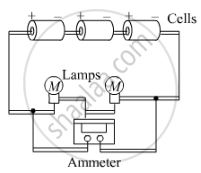
A continuous and closed path of an electric current is called an electric circuit.
Maharashtra State Board: Class 9, 11
CISCE: Class 9, 10, 12
Tamil Nadu Board of Secondary Education: Class 7, 10, 12
National Testing Agency: Class 12
Formula: Electric Current
I = \[\frac {Q}{t}\]
Where:
- I = electric current
- Q = charge flowing through the conductor
- t = time taken
SI unit of current = ampere (A).
Maharashtra State Board: Class 9, 11
CISCE: Class 9, 10, 12
Tamil Nadu Board of Secondary Education: Class 10, 12
National Testing Agency: Class 12
Understanding Electric Current
1. Explanation
- Electric current is produced when electric charges flow through a conductor.
- In metallic conductors, electrons are the charge carriers.
- Current exists only when there is a closed circuit.
2. Electric Circuit
- A circuit must be continuous and closed for current to flow.
- If the switch is open or the circuit is broken, current stops flowing, and electrical devices stop working.
3. Direction of Current
- Electrons move from the negative terminal to the positive terminal.
- By convention, current is taken to flow from the positive terminal to the negative terminal in the external circuit.
- Therefore, conventional current is opposite to electron flow.
4. Important facts
- Charge on one electron is approximately 1.6 × 10⁻¹⁹ C.
- Small currents are expressed as: 1 mA = 10-3 A and 1 μA = 10-6 A.
- The source material also presents current as a useful quantity for describing charge flow in circuits and devices.
5. Quick process view
- Charge moves through a conductor.
- Movement occurs through a closed path called an electric circuit.
- The amount of charge passing per unit time gives the current.
- Current is measured in amperes.
Conventional Current vs Electron Flow
- Conventional current is defined as the direction in which positive charge would flow — from the positive terminal to the negative terminal in the external circuit.
- This convention was set by Benjamin Franklin (1752), before the electron was discovered.
- Electron flow is the actual movement of electrons, from the negative terminal to the positive terminal, since electrons are negatively charged and are attracted toward the positive terminal.
- J.J. Thomson discovered the electron in 1897, revealing that actual charge carriers move opposite to the conventional direction.
- Circuit calculations give identical results whether conventional flow or electron flow is used, so both conventions remain valid in practice.
| Aspect | Conventional Current | Electron Flow |
|---|---|---|
| Direction | Positive to negative terminal | Negative to positive terminal |
| Basis | Historical convention (Franklin) | Actual electron motion (Thomson) |
| Used in | Circuit diagrams, textbooks | Physical/electronic explanation |
Tamil Nadu Board of Secondary Education: Class 12
Charge Carriers in Different Media
Charge carriers are the particles responsible for carrying electric charge and producing current in a medium.
- Metals: Free (valence) electrons act as charge carriers, forming a "sea" of mobile electrons within the metal lattice.
- Electrolytes (e.g., salt solutions): Both positive ions (cations) and negative ions (anions) act as charge carriers, moving toward oppositely charged electrodes.
- Ionised gases (plasma): Free electrons and positive ions serve as charge carriers once the gas is ionised under high potential.
- Semiconductors: Free electrons and holes act as charge carriers.
- In a vacuum, free electrons themselves can act as charge carriers.
DC vs AC (Direct Current vs Alternating Current)
| Feature | Direct Current (DC) | Alternating Current (AC) |
|---|---|---|
| Direction | Flows in one direction only | Periodically reverses direction |
| Magnitude | Generally constant (in ideal DC) | Varies sinusoidally with time |
| Example expression | I = constant | i = Imsin(ωt) |
| Common sources | Batteries, cells | Mains power supply, generators |
| Measured value | Simple average | RMS (root mean square) value used for practical measurement |
-
RMS value of AC is defined as the square root of the mean of the squares of the instantaneous current values over one cycle.
Closed Circuit and Role of a Switch
- Electric current flows only when the circuit forms a complete (closed) loop from one terminal of the source, through the components, and back to the other terminal.
- A switch is used to make (close) or break (open) this loop:
Switch ON (closed circuit) → current flows, connected devices operate.
Switch OFF (open circuit) → no current flows, devices stop working. - This is a foundational Class 10-level concept usually paired with circuit diagrams showing cell, switch, and load (e.g., a bulb).
Example 1
Question: A charge of 30 C flows through a wire in 2 minutes. Find the current.
Solution: Given, Q = 30 C
Time, t = 2 min = 120 s
Using I = \[\frac {Q}{t}\],
Answer: 0.25 A.
Example 2
Question: A current of 0.5 A flows through a bulb for 10 minutes. Find the charge passed.
Solution: Given, I = 0.5 A
Time, t = 10 min = 600 s
Using Q = It,
Answer: 300 C.
Maharashtra State Board: Class 8, 9, 11
CISCE: Class 9, 10, 12
Tamil Nadu Board of Secondary Education: Class 7, 10, 12
National Testing Agency: Class 12
Real-Life Application
- Electric current is used in lighting devices such as bulbs and torches.
- Household appliances work only when current flows through a complete circuit.
- Very small currents are important in electronic circuits, sensors, and mobile devices.
- Lightning is also an example of a large-scale movement of electric charges mentioned in the source references.
Maharashtra State Board: Class 8, 9, 11
CISCE: Class 9, 10, 12
Tamil Nadu Board of Secondary Education: Class 7, 10, 12
National Testing Agency: Class 12
Key Points: Electric Current
- Electricity is a convenient and controllable form of energy widely used in homes, industries, schools, and hospitals.
- Electric current is produced when electric charges flow through a conductor, and it flows only through a closed, continuous electric circuit.
- A switch completes or breaks the circuit; when the circuit is broken, current stops flowing, and devices like bulbs do not glow.
- Electric current is the rate of flow of charge, given by the relation I = Q / t, where Q is charge and t is time.
- In metallic wires, electrons are the charge carriers, but by convention, current flows from the positive to the negative terminal, in the opposite direction to electron flow.