Topics
Electric Charges and Fields
- Electric Charges
- Conductors and Insulators
- Properties of Electric Charge
- Coulomb’s Law
- Forces between Multiple Charges
- Electric Field
- Electric Field Due to a System of Charges
- Physical Significance of Electric Field
- Electric Field Lines
- Electric Flux
- Electric Dipole
- Dipole in a Uniform External Field
- Continuous Charge Distribution
- Gauss’s Law
- Application of Gauss' Law
Electrostatics
Current Electricity
Electrostatic Potential and Capacitance
- Electric Potential and Potential Energy
- Electrostatic Potential
- Electric Potential Due to a Point Charge
- Potential Due to an Electric Dipole
- Potential due to a System of Charges
- Equipotential Surfaces
- Relation Between Electric Field and Electrostatic Potential
- Potential Energy of a System of Charges
- Potential Energy of a Single Charge
- Potential Energy of a System of Two Charges in an External Field
- Potential Energy of a Dipole in an External Field
- Electrostatics of Conductors
- Dielectrics and Polarisation
- Capacitors and Capacitance
- The Parallel Plate Capacitor
- Effect of Dielectric on Capacitance
- Combination of Capacitors
- Energy Stored in a Charged Capacitor
Magnetic Effects of Current and Magnetism
Current Electricity
- Electric Current
- Electric Currents in Conductors
- Ohm's Law
- Drift of Electrons and the Origin of Resistivity
- Mobility of Electrons
- Limitations of Ohm’s Law
- Resistivity of Various Materials
- Temperature Dependence of Resistivity
- Electrical Energy and Power in Conductors
- Cells, EMF, and Internal Resistance
- Cells in Series and in Parallel
- Kirchhoff’s Laws
- Wheatstone Bridge
Moving Charges and Magnetism
- Electromagnetism
- Magnetic force
- Motion in a Magnetic Field
- Magnetic Field Due to a Current-carrying Conductor: Biot-savart's Law
- Applications of Biot-Savart's Law > Magnetic Field at the Axis of a Circular Current-carrying Loop
- Ampere’s Circuital Law
- Solenoid
- Force Between Two Parallel Currents (Ampere’s Law)
- Torque on a Rectangular Current Loop in a Uniform Magnetic Field
- Circular Current Loop as a Magnetic Dipole
- Moving Coil Galvanometer
- Kirchhoff’s Laws
Electromagnetic Induction and Alternating Currents
Magnetism and Matter
Electromagnetic Waves
Optics
Electromagnetic Induction
Alternating Current
Dual Nature of Radiation and Matter
Electromagnetic Waves
Atoms and Nuclei
Electronic Devices
Ray Optics and Optical Instruments
- Ray Optics Or Geometrical Optics
- Reflection of Light by Spherical Mirrors
- Sign Convention for Reflection by Spherical Mirrors
- Focal Length of Spherical Mirrors
- Mirror Equation of Spherical Mirrors
- Refraction of Light
- Total Internal Reflection
- Applications of Total Internal Reflection
- Refraction at a Spherical Surfaces
- Refraction by a Lens
- Power of a Lens
- Combined Focal Length of Two Thin Lenses in Contact
- Refraction of Light through a Prism
- Introduction to Optical Instruments
- Microscope and it’s types
- Telescope
Communication Systems
Wave Optics
- Introduction to Wave Optics
- Huygens Principle
- Refraction of a Plane Wave
- Refraction at a Rarer Medium
- Reflection of a Plane Wave by a Plane Surface
- Coherent and Incoherent Addition of Waves
- Interference of Light Waves and Young’s Experiment
- Diffraction of Light
- The Single Slit
- Seeing the Single Slit Diffraction Pattern
- Polarisation of Light
Dual Nature of Radiation and Matter
- Understanding Dual Nature of Radiation and Matter
- Electron Emission
- Photoelectric Effect - Hertz’s Observations
- Photoelectric Effect - Hallwachs’ and Lenard’s Observations
- Experimental Study of Photoelectric Effect
- Effects of Intensity and Frequency on Photocurrent
- Photoelectric Effect and Wave Theory of Light
- Einstein’s Photoelectric Equation: Energy Quantum of Radiation
- Particle Nature of Light: The Photon
- Wave Nature of Matter
The Special Theory of Relativity
Atoms
Nuclei
Semiconductor Electronics - Materials, Devices and Simple Circuits
Communication Systems
- Detection of Amplitude Modulated Wave
- Production of Amplitude Modulated Wave
- Basic Terminology Used in Electronic Communication Systems
- Sinusoidal Waves
- Modulation and Its Necessity
- Amplitude Modulation (AM)
- Need for Modulation and Demodulation
- Satellite Communication
- Propagation of EM Waves
- Bandwidth of Transmission Medium
- Bandwidth of Signals
The Special Theory of Relativity
- The Special Theory of Relativity
- The Principle of Relativity
- Maxwell'S Laws
- Kinematical Consequences
- Dynamics at Large Velocity
- Energy and Momentum
- The Ultimate Speed
- Twin Paradox
Definition: Photocurrent
The current produced due to the flow of photoelectrons in an external circuit is called photocurrent.
Definition: Saturation Current
The maximum photocurrent obtained when all emitted photoelectrons are collected by the anode is called the saturation current.
Definition: Stopping Potential
The minimum negative potential applied to the collector plate that stops even the fastest photoelectrons is called the stopping potential.
Experimental Idea at a Glance
Basic Setup
A photosensitive plate is illuminated by light. The emitted electrons are attracted toward another plate, and the resulting current is measured.
Experimental Variable
- Intensity of light.
- Potential difference between emitter and collector.
- Frequency of incident radiation.
Observation
- Change in photocurrent.
- Change in saturation current.
- Change in stopping potential.
Effect of Intensity on Photocurrent
Main Observation
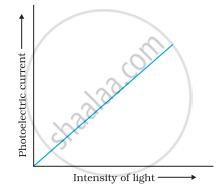
When the frequency of incident light is kept constant and its intensity is increased, the photocurrent increases.
Reason
Higher intensity means a greater number of photons fall on the surface per second. As a result, more electrons are emitted per second, increasing the current.
- Photocurrent is directly proportional to the intensity of incident light, provided the frequency is above the threshold frequency.
- Saturation current also increases with intensity.
- Stopping potential does not increase with intensity.
Effect of Potential on Photocurrent
Main Observation
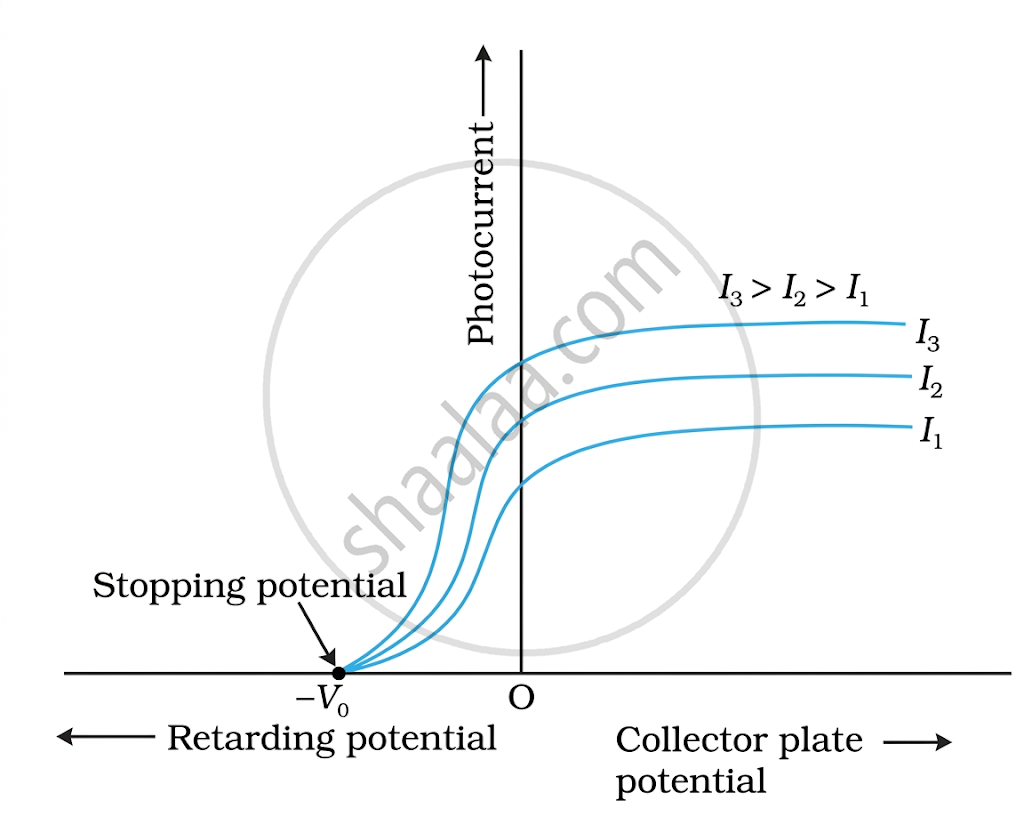
When the collector plate is made more positive, photocurrent increases and finally reaches a maximum value called the saturation current.
Cause of Saturation
At sufficiently high positive potential, all emitted photoelectrons are collected. Beyond this point, increasing potential further does not increase current.
Negative Potential Case
When the collector plate is made negative, it repels photoelectrons. Therefore, photocurrent decreases.
When the negative potential becomes large enough, even the fastest photoelectrons cannot reach the collector, and the current becomes zero.
That potential is called the stopping potential or cut-off potential.
Effect of Frequency on Stopping Potential
Main Observation
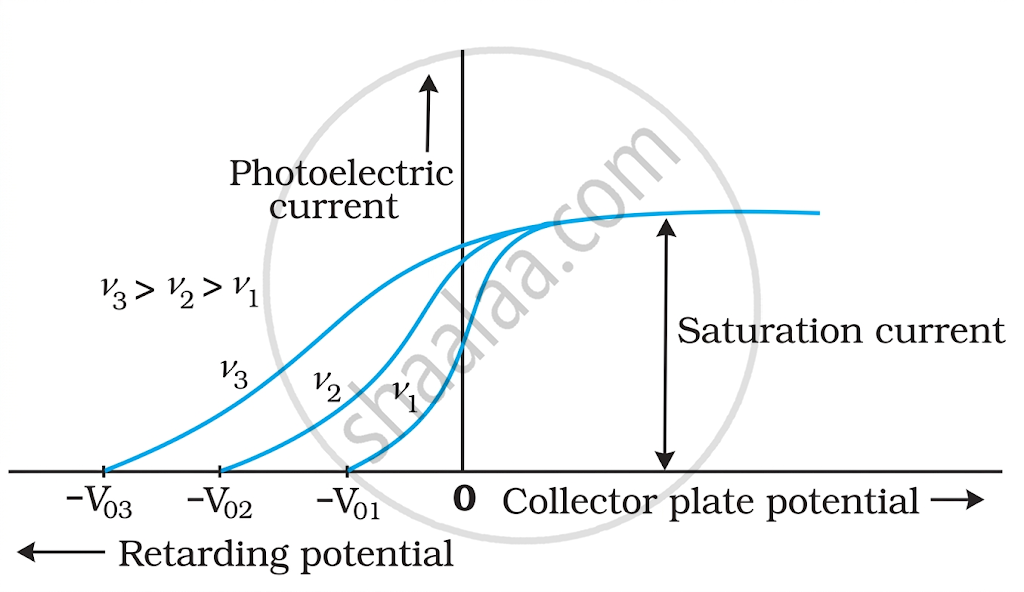
For a given photosensitive material, the stopping potential increases when the frequency of the incident radiation increases.
Meaning
Higher frequency radiation gives greater maximum kinetic energy to emitted photoelectrons. Therefore, a larger negative potential is required to stop them.
Key Conclusion
- Maximum kinetic energy depends on frequency.
- Maximum kinetic energy does not depend on intensity.
- Stopping potential is therefore dependent on frequency, not on intensity.
Threshold Condition
If the frequency of light is below the threshold frequency, no photoelectric emission occurs, no matter how high the intensity is.
Instantaneous Nature of Photoelectric Emission
Photoelectric emission starts almost immediately when radiation of frequency greater than the threshold frequency falls on the metal surface.
The time lag between illumination and emission is extremely small, of the order of 10−9 s or less.
