Topics
Electric Charges and Fields
- Electric Charges
- Conductors and Insulators
- Properties of Electric Charge
- Coulomb’s Law
- Forces between Multiple Charges
- Electric Field
- Electric Field Due to a System of Charges
- Physical Significance of Electric Field
- Electric Field Lines
- Electric Flux
- Electric Dipole
- Dipole in a Uniform External Field
- Continuous Charge Distribution
- Gauss’s Law
- Application of Gauss' Law
Electrostatics
Current Electricity
Electrostatic Potential and Capacitance
- Electric Potential and Potential Energy
- Electrostatic Potential
- Electric Potential Due to a Point Charge
- Potential Due to an Electric Dipole
- Potential due to a System of Charges
- Equipotential Surfaces
- Relation Between Electric Field and Electrostatic Potential
- Potential Energy of a System of Charges
- Potential Energy of a Single Charge
- Potential Energy of a System of Two Charges in an External Field
- Potential Energy of a Dipole in an External Field
- Electrostatics of Conductors
- Dielectrics and Polarisation
- Capacitors and Capacitance
- The Parallel Plate Capacitor
- Effect of Dielectric on Capacitance
- Combination of Capacitors
- Energy Stored in a Charged Capacitor
Magnetic Effects of Current and Magnetism
Current Electricity
- Electric Current
- Electric Currents in Conductors
- Ohm's Law
- Drift of Electrons and the Origin of Resistivity
- Mobility of Electrons
- Limitations of Ohm’s Law
- Resistivity of Various Materials
- Temperature Dependence of Resistivity
- Electrical Energy and Power in Conductors
- Cells, EMF, and Internal Resistance
- Cells in Series and in Parallel
- Kirchhoff’s Laws
- Wheatstone Bridge
Moving Charges and Magnetism
- Electromagnetism
- Magnetic force
- Motion in a Magnetic Field
- Magnetic Field Due to a Current-carrying Conductor: Biot-savart's Law
- Applications of Biot-Savart's Law > Magnetic Field at the Axis of a Circular Current-carrying Loop
- Ampere’s Circuital Law
- Solenoid
- Force Between Two Parallel Currents (Ampere’s Law)
- Torque on a Rectangular Current Loop in a Uniform Magnetic Field
- Circular Current Loop as a Magnetic Dipole
- Moving Coil Galvanometer
- Kirchhoff’s Laws
Electromagnetic Induction and Alternating Currents
Magnetism and Matter
Electromagnetic Waves
Optics
Electromagnetic Induction
Alternating Current
Dual Nature of Radiation and Matter
Electromagnetic Waves
Atoms and Nuclei
Electronic Devices
Ray Optics and Optical Instruments
- Ray Optics Or Geometrical Optics
- Reflection of Light by Spherical Mirrors
- Sign Convention for Reflection by Spherical Mirrors
- Focal Length of Spherical Mirrors
- Mirror Equation of Spherical Mirrors
- Refraction of Light
- Total Internal Reflection
- Applications of Total Internal Reflection
- Refraction at a Spherical Surfaces
- Refraction by a Lens
- Power of a Lens
- Combined Focal Length of Two Thin Lenses in Contact
- Refraction of Light through a Prism
- Introduction to Optical Instruments
- Microscope and it’s types
- Telescope
Communication Systems
Wave Optics
- Introduction to Wave Optics
- Huygens Principle
- Refraction of a Plane Wave
- Refraction at a Rarer Medium
- Reflection of a Plane Wave by a Plane Surface
- Coherent and Incoherent Addition of Waves
- Interference of Light Waves and Young’s Experiment
- Diffraction of Light
- The Single Slit
- Seeing the Single Slit Diffraction Pattern
- Polarisation of Light
Dual Nature of Radiation and Matter
- Understanding Dual Nature of Radiation and Matter
- Electron Emission
- Photoelectric Effect - Hertz’s Observations
- Photoelectric Effect - Hallwachs’ and Lenard’s Observations
- Experimental Study of Photoelectric Effect
- Effects of Intensity and Frequency on Photocurrent
- Photoelectric Effect and Wave Theory of Light
- Einstein’s Photoelectric Equation: Energy Quantum of Radiation
- Particle Nature of Light: The Photon
- Wave Nature of Matter
The Special Theory of Relativity
Atoms
Nuclei
Semiconductor Electronics - Materials, Devices and Simple Circuits
Communication Systems
- Detection of Amplitude Modulated Wave
- Production of Amplitude Modulated Wave
- Basic Terminology Used in Electronic Communication Systems
- Sinusoidal Waves
- Modulation and Its Necessity
- Amplitude Modulation (AM)
- Need for Modulation and Demodulation
- Satellite Communication
- Propagation of EM Waves
- Bandwidth of Transmission Medium
- Bandwidth of Signals
The Special Theory of Relativity
- The Special Theory of Relativity
- The Principle of Relativity
- Maxwell'S Laws
- Kinematical Consequences
- Dynamics at Large Velocity
- Energy and Momentum
- The Ultimate Speed
- Twin Paradox
Alpha-Particle Trajectory
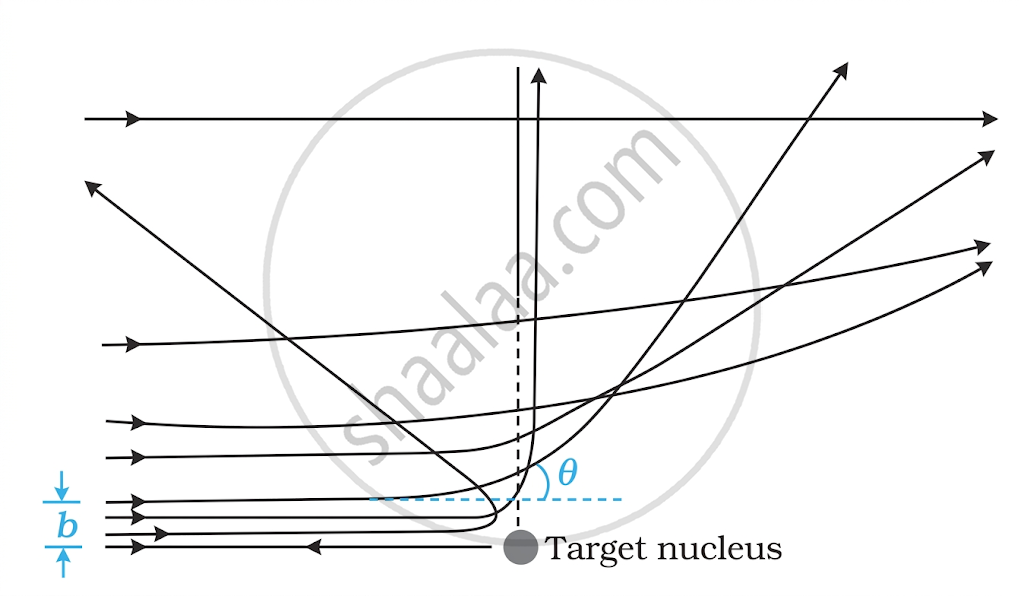
The figure shows the trajectory of alpha-particles in the Coulomb field of a target nucleus, along with the impact parameter bb and scattering angle θ.
The trajectory traced by an alpha particle depends on the impact parameter b of the collision. The impact parameter is the perpendicular distance of the initial velocity vector of the alpha particle from the centre of the nucleus.
A given beam of alpha-particles has a distribution of impact parameters, so the beam is scattered in various directions with different probabilities. In a beam, all particles have nearly the same kinetic energy.
Effect of Impact Parameter
- An alpha particle close to the nucleus, that is, with a small impact parameter, suffers large scattering.
- In a head-on collision, the impact parameter is minimum, and the alpha particle rebounds.
- In this case, the scattering angle is approximately equal to ππ.
- For a large impact parameter, the alpha particle goes nearly undeviated.
- In that case, the deflection is small, and the scattering angle is approximately equal to 0.
Main Conclusion from Scattering
Only a small fraction of the incident particles rebound. This indicates that the number of alpha-particles undergoing head-on collision is small.
This further implies that the atom's mass and positive charge are concentrated in a small volume. Therefore, Rutherford scattering is a powerful way to determine an upper limit to the size of the nucleus.
Example 1
Question idea
In Rutherford’s nuclear model, the nucleus, with a radius of about 10−15 m, is analogous to the sun, and the electrons move in orbits with radii of about 10−10 m, like the Earth around the sun. The example asks whether, if the solar system had the same proportions as the atom, the Earth would be closer to or farther from the Sun than it actually is.
Given values
- Radius of nucleus: about 10−15 m.
- Radius of electron orbit: about 10−10 m.
- Radius of Earth’s orbit: about 1.5 × 10¹¹ m.
- Radius of the Sun: 7 × 10⁸ m.
Solution steps
-
Ratio of radius of electron orbit to radius of nucleus:
\[\frac{10^{-10}}{10^{-15}}=10^5\]
This means the electron’s orbital radius is 105 times the nucleus's radius.
-
If the radius of the Earth’s orbit around the Sun were 105 times larger than the radius of the Sun, then:
105 × 7 × 108 m = 7 × 10¹³ m
This is more than 100 times greater than the actual orbital radius of the Earth.
Result
The Earth would be much farther away from the Sun. This implies that an atom contains a much greater fraction of empty space than our solar system does.
Example 2
Question
In a Geiger-Marsden experiment, what is the distance of closest approach to the nucleus of a 7.7 MeV alpha particle before it momentarily comes to rest and reverses direction?
Key idea
Throughout the scattering process, the total mechanical energy of the system consisting of an alpha particle and a gold nucleus is conserved. The initial mechanical energy is the kinetic energy K of the incoming alpha particle. The final mechanical energy, when the alpha-particle momentarily stops, is the electric potential energy U of the system.
Let d be the centre-to-centre distance between the alpha-particle and the gold nucleus at the alpha-particle's stopping point.
Energy relation
Thus, the distance of closest approach is:
These relations are directly stated in the source material.
Numerical values used
-
Maximum kinetic energy of alpha-particles of natural origin: 7.7 MeV or 1.2 × 10⁻¹² J.
-
\[\frac {1}{4πε_0}\] = 9.0 × 10⁹ N m²/C².
-
e = 1.6 × 10⁻¹⁹ C.
Substituting these values gives:
For gold, Z = 79, so:
Also, 1 fm (fermi) = 10−15 m.
Result and conclusion
The radius of the gold nucleus is therefore less than 3.0 × 10⁻¹⁴ m. The source then states that this is not in good agreement with the observed result, as the actual radius of the gold nucleus is 6 fm.
The cause of the discrepancy is that the distance of closest approach is considerably larger than the sum of the radii of the gold nucleus and the alpha particle. Thus, the alpha particle reverses its motion without ever actually touching the gold nucleus.
