Topics
Electric Charges and Fields
- Electric Charge
- Conductors and Insulators
- Properties of Electric Charge
- Coulomb’s Law
- Forces between Multiple Charges
- Electric Field
- Electric Field Due to a System of Charges
- Physical Significance of Electric Field
- Electric Field Lines
- Electric Flux
- Electric Dipole
- Dipole in a Uniform External Field
- Continuous Charge Distribution
- Gauss’s Law
- Application of Gauss' Law
Electrostatics
Current Electricity
Electrostatic Potential and Capacitance
- Electric Potential and Potential Energy
- Electrostatic Potential
- Electric Potential Due to a Point Charge
- Potential Due to an Electric Dipole
- Potential due to a System of Charges
- Equipotential Surfaces
- Relation Between Electric Field and Electrostatic Potential
- Potential Energy of a System of Charges
- Potential Energy of a Single Charge
- Potential Energy of a System of Two Charges in an External Field
- Potential Energy of a Dipole in an External Field
- Electrostatics of Conductors
- Dielectrics and Polarisation
- Capacitors and Capacitance
- The Parallel Plate Capacitor
- Effect of Dielectric on Capacitance
- Combination of Capacitors
- Energy Stored in a Charged Capacitor
Magnetic Effects of Current and Magnetism
Current Electricity
- Electric Current
- Electric Currents in Conductors
- Ohm's Law
- Drift of Electrons and the Origin of Resistivity
- Mobility of Electrons
- Limitations of Ohm’s Law
- Resistivity of Various Materials
- Temperature Dependence of Resistivity
- Electrical Energy and Power in Conductors
- Cells, EMF, and Internal Resistance
- Cells in Series and in Parallel
- Kirchhoff’s Laws
- Wheatstone Bridge
Electromagnetic Induction and Alternating Currents
Moving Charges and Magnetism
- Electromagnetism
- Magnetic force
- Motion in a Magnetic Field
- Magnetic Field Due to a Current-carrying Conductor: Biot-savart's Law
- Applications of Biot-Savart's Law > Magnetic Field at the Axis of a Circular Current-carrying Loop
- Ampere’s Circuital Law
- Solenoid
- Force Between Two Parallel Currents (Ampere’s Law)
- Torque on a Rectangular Current Loop in a Uniform Magnetic Field
- Circular Current Loop as a Magnetic Dipole
- Moving Coil Galvanometer
- Kirchhoff’s Laws
Magnetism and Matter
Electromagnetic Waves
Electromagnetic Induction
Optics
Alternating Current
Dual Nature of Radiation and Matter
Electromagnetic Waves
Atoms and Nuclei
Ray Optics and Optical Instruments
- Ray Optics Or Geometrical Optics
- Reflection of Light by Spherical Mirrors
- Sign Convention for Reflection by Spherical Mirrors
- Focal Length of Spherical Mirrors
- Mirror Equation of Spherical Mirrors
- Refraction of Light
- Total Internal Reflection
- Applications of Total Internal Reflection
- Refraction at a Spherical Surfaces
- Refraction by a Lens
- Power of a Lens
- Combined Focal Length of Two Thin Lenses in Contact
- Refraction Through a Prism
- Introduction to Optical Instruments
- Microscope and it’s types
- Telescope
Electronic Devices
Communication Systems
Wave Optics
- Introduction to Wave Optics
- Huygens Principle
- Refraction of a Plane Wave
- Refraction at a Rarer Medium
- Reflection of a Plane Wave by a Plane Surface
- Coherent and Incoherent Addition of Waves
- Interference of Light Waves and Young’s Experiment
- Diffraction of Light
- The Single Slit
- Seeing the Single Slit Diffraction Pattern
- Polarisation of Light
Dual Nature of Radiation and Matter
- Understanding Dual Nature of Radiation and Matter
- Electron Emission
- Photoelectric Effect - Hertz’s Observations
- Photoelectric Effect - Hallwachs’ and Lenard’s Observations
- Experimental Study of Photoelectric Effect
- Effects of Intensity and Frequency on Photocurrent
- Photoelectric Effect and Wave Theory of Light
- Einstein’s Photoelectric Equation: Energy Quantum of Radiation
- Particle Nature of Light: The Photon
- Wave Nature of Matter
The Special Theory of Relativity
Atoms
Nuclei
Semiconductor Electronics - Materials, Devices and Simple Circuits
Communication Systems
- Detection of Amplitude Modulated Wave
- Production of Amplitude Modulated Wave
- Basic Terminology Used in Electronic Communication Systems
- Sinusoidal Waves
- Modulation and Its Necessity
- Amplitude Modulation (AM)
- Need for Modulation and Demodulation
- Satellite Communication
- Propagation of EM Waves
- Bandwidth of Transmission Medium
- Bandwidth of Signals
The Special Theory of Relativity
- The Special Theory of Relativity
- The Principle of Relativity
- Maxwell'S Laws
- Kinematical Consequences
- Dynamics at Large Velocity
- Energy and Momentum
- The Ultimate Speed
- Twin Paradox
Definition: Real Image
An image formed when reflected rays actually converge at a point. A real image can be obtained on a screen and is located in front of the mirror.
Definition: Virtual Image
An image formed when reflected rays do not actually meet, but appear to diverge from a point. A virtual image cannot be obtained on a screen and is located behind the mirror.
Principal Rays for Image Formation
To locate an image in a spherical mirror, any two of the following standard rays are used:
- A ray parallel to the principal axis — after reflection- passes through the principal focus F (concave) or appears to diverge from F (convex).
- Ray through the principal focus — after reflection- travels parallel to the principal axis.
- Ray through the centre of curvature C — Retraces its path after reflection (falls normally on the mirror surface).
- Ray incident at the pole is reflected according to the laws of reflection and makes equal angles with the principal axis.
Cartesian Sign Convention
All distances are measured from the pole P of the mirror.
| Quantity | Sign Rule |
|---|---|
| Distances in the direction of incident light | Positive (+) |
| Distances opposite to the direction of incident light | Negative (−) |
| Heights above the principal axis | Positive (+) |
| Heights below the principal axis | Negative (−) |
Key results from sign convention:
- Object distance u is always negative for a real object placed in front of the mirror.
- Focal length f is negative for a concave mirror (focus is in front).
- Focal length f is positive for a convex mirror (focus is behind the mirror).
- Image distance v is negative if the image is real (in front), positive if the image is virtual (behind the mirror).
Formula: Mirror Equation
\[\frac {1}{v}\] + \[\frac {1}{u}\] = \[\frac {1}{f}\]
where:
- v = image distance (measured from the pole)
- u = object distance (measured from the pole)
- f = focal length of the mirror
Relation between focal length and radius of curvature: f = \[\frac {R}{2}\]
Derivation of the Mirror Equation
The derivation uses paraxial rays (rays close to the principal axis) and the principle of similar triangles.
Step 1: Set Up
Consider an object AB placed on the principal axis in front of a concave mirror with centre of curvature C and focus F. A ray from the top of the object (B) parallel to the principal axis strikes the mirror at D and reflects through F. Another ray from B passing through C strikes the mirror and retraces its path. These two reflected rays meet at B′, giving the image A′B′.
Step 2: Similar Triangles (first pair):
Triangles A′B′F and MPF are similar (where M is the point where the ray from B meets the mirror, and MP is the height of that ray above the axis):
Since PM = BA (same height, paraxial approximation):
Step 3: Similar Triangles (second pair):
Triangles A′B′A and ABP are also similar:
Step 4: Combining equations (1) and (2):
Step 5: Applying sign convention:
Using Cartesian sign convention:
- B′F = v − f
- FP = f
- A′P = v
- AP = u
Substituting:
Dividing through by v:
Rearranging:
Example 1
Question: What happens if the lower half of a concave mirror is covered?
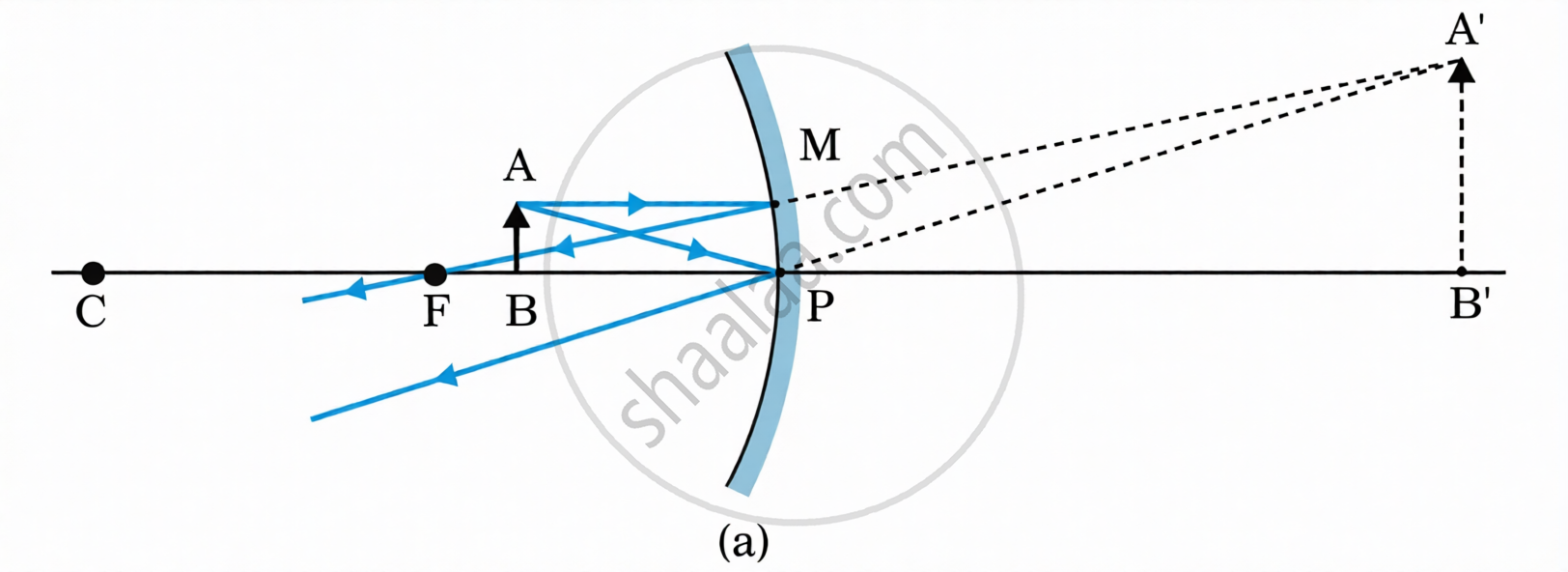
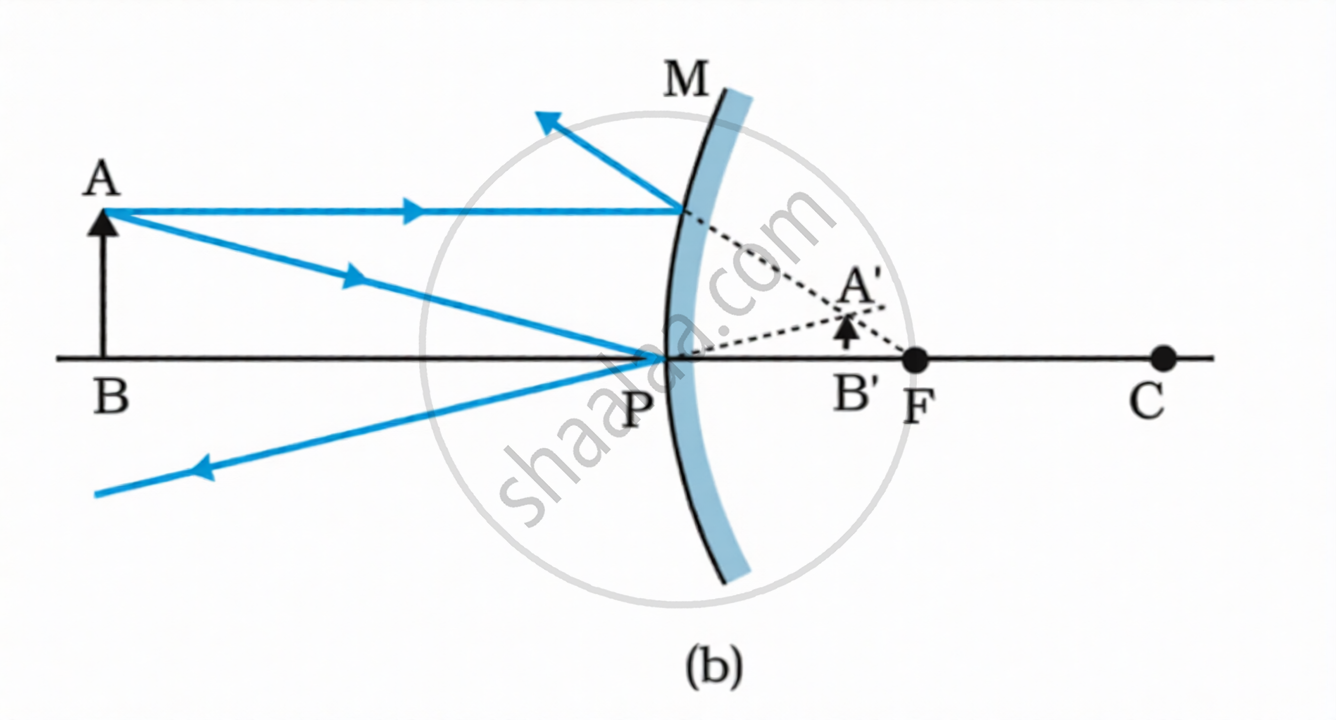
Simple steps:
- The obvious wrong guess: You might think only the upper half of the object will appear in the image.
- The correct reasoning: The laws of reflection still apply perfectly to every point on the remaining (upper) half of the mirror.
- Conclusion on image shape: Each point of the object still sends rays to the uncovered part of the mirror, so the full image of the whole object is still formed.
- Actual changes: Since the reflecting area is now half, fewer rays contribute to the image → the image becomes dimmer (half the intensity), not half the object.
Example 2
Question: A mobile phone lies along the principal axis of a concave mirror. What does the image look like?
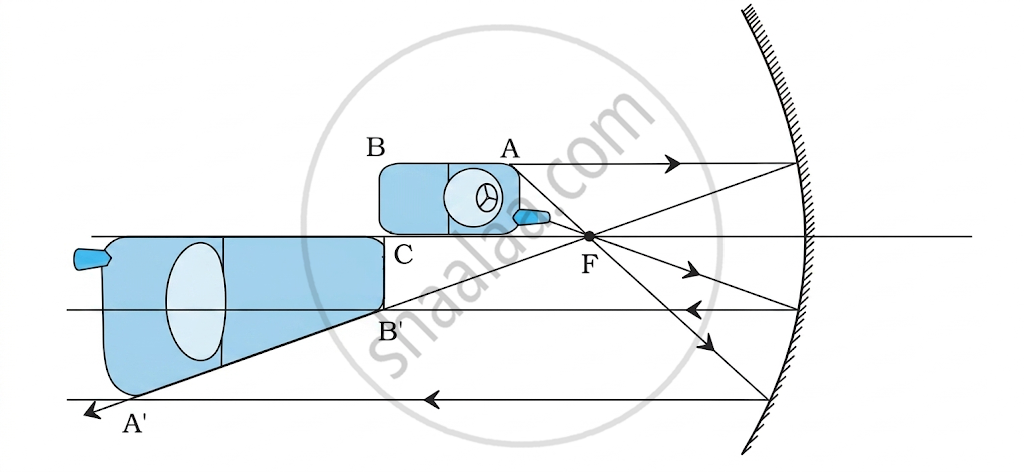
Simple steps:
- Understand the setup: The phone is lying flat along the principal axis, so different parts of the phone are at different distances from the mirror.
- Part perpendicular to the axis: The part of the phone on a plane perpendicular to the principal axis (say, point B) forms an image B′ in the same plane and of the same transverse size — so BC = B′C.
- Distortion occurs because the phone extends along the principal axis; different parts of it are at different object distances. The mirror equation yields different image distances and magnifications for each part → magnification is not uniform across the phone's length.
- Location matters: as you move the phone closer to or farther from the mirror, the degree of distortion changes because magnification varies across the phone's length.
Example 3
Given: Radius of curvature R = 15 cm, so focal length f = −R/2 = −7.5 cm
Case (i): Object at u = −10 cm
Step 1: Write the mirror equation:
Step 2: Substitute:
Step 3: Solve for v:
Step 4: Find magnification:
Step 5: Interpret:
- v is negative → image is in front of mirror → real
- m is negative → image is inverted
- |m| = 3 → image is 3 times magnified
Case (ii): Object at u = −5 cm (between F and P)
Step 1: Substitute:
- \[\frac {1}{v}\] + \[\frac {1}{−5}\] = \[\frac {1}{−7.5}\]
Step 2: Solve for v:
- \[\frac {1}{v}\] = \[\frac {1}{−7.5}\] + \[\frac {1}{5}\] = \[\frac {−5+7.5}{37.5}\] = \[\frac {2.5}{37.5}\]
- v = +15 cm
Step 3: Find magnification:
- m = −\[\frac {v}{u}\] = −\[\frac {+15}{−5}\] = +3
Step 4: Interpret:
- v is positive → image is behind the mirror → virtual
- m is positive → image is erect
- |m| = 3 → image is 3 times magnified
Example 4
Given: Convex mirror → f = +R/2 = +1m. The jogger moves at 5 m/s towards the mirror.
Core idea: Use the rearranged mirror equation to find the image distance first, then calculate how fast the image shifts in 1 second.
- v = \[\frac {fu}{u−f}\]
Step 1: Find the image position at the starting distance.
Step 2: After 1 second, the jogger has moved 5 m closer. Find the new image position.
Step 3: The difference in the two image positions gives the image shift in 1 second = the average image speed.
Case (a): Jogger at u = −39 m
- At u = −39 m: v = \[\frac{1\times(-39)}{-39-1}=\frac{-39}{-40}=\frac{39}{40}\mathrm{~m}\]
After 1 s, u = −34 m:
- v = \[\frac{1\times(-34)}{-34-1}=\frac{-34}{-35}=\frac{34}{35}\mathrm{~m}\]
Image shift:
- \[\frac{39}{40}-\frac{34}{35}=\frac{1365-1360}{1400}=\frac{5}{1400}=\frac{1}{280}\mathrm{m}\]
Image speed ≈ 1/280 m/s.
