Topics
Electrostatics
Electric Charges and Fields
- Electric Charges
- Conductors and Insulators
- Properties of Electric Charge
- Coulomb’s Law
- Forces between Multiple Charges
- Electric Field
- Electric Field Due to a System of Charges
- Physical Significance of Electric Field
- Electric Field Lines
- Electric Flux
- Electric Dipole
- Dipole in a Uniform External Field
- Continuous Charge Distribution
- Gauss’s Law
- Application of Gauss' Law
Current Electricity
Electrostatic Potential and Capacitance
- Electric Potential and Potential Energy
- Electrostatic Potential
- Electric Potential Due to a Point Charge
- Potential Due to an Electric Dipole
- Potential due to a System of Charges
- Equipotential Surfaces
- Relation Between Electric Field and Electrostatic Potential
- Potential Energy of a System of Charges
- Potential Energy of a Single Charge
- Potential Energy of a System of Two Charges in an External Field
- Potential Energy of a Dipole in an External Field
- Electrostatics of Conductors
- Dielectrics and Polarisation
- Capacitors and Capacitance
- The Parallel Plate Capacitor
- Effect of Dielectric on Capacitance
- Combination of Capacitors
- Energy Stored in a Charged Capacitor
Magnetic Effects of Current and Magnetism
Current Electricity
- Electric Current
- Electric Currents in Conductors
- Ohm's Law
- Drift of Electrons and the Origin of Resistivity
- Mobility of Electrons
- Limitations of Ohm’s Law
- Resistivity of Various Materials
- Temperature Dependence of Resistivity
- Electrical Energy and Power in Conductors
- Cells, EMF, and Internal Resistance
- Cells in Series and in Parallel
- Kirchhoff’s Laws
- Wheatstone Bridge
Moving Charges and Magnetism
- Electromagnetism
- Magnetic force
- Motion in a Magnetic Field
- Magnetic Field Due to a Current-carrying Conductor: Biot-savart's Law
- Applications of Biot-Savart's Law > Magnetic Field at the Axis of a Circular Current-carrying Loop
- Ampere’s Circuital Law
- Solenoid
- Force Between Two Parallel Currents (Ampere’s Law)
- Torque on a Rectangular Current Loop in a Uniform Magnetic Field
- Circular Current Loop as a Magnetic Dipole
- Moving Coil Galvanometer
- Kirchhoff’s Laws
Electromagnetic Induction and Alternating Currents
Electromagnetic Waves
Magnetism and Matter
Optics
Electromagnetic Induction
Alternating Current
Dual Nature of Radiation and Matter
Atoms and Nuclei
Electromagnetic Waves
Electronic Devices
Ray Optics and Optical Instruments
- Ray Optics Or Geometrical Optics
- Reflection of Light by Spherical Mirrors
- Sign Convention for Reflection by Spherical Mirrors
- Focal Length of Spherical Mirrors
- Mirror Equation of Spherical Mirrors
- Refraction of Light
- Total Internal Reflection
- Applications of Total Internal Reflection
- Refraction at a Spherical Surfaces
- Refraction by a Lens
- Power of a Lens
- Combined Focal Length of Two Thin Lenses in Contact
- Refraction of Light through a Prism
- Introduction to Optical Instruments
- Microscope and it’s types
- Telescope
Wave Optics
- Introduction to Wave Optics
- Huygens Principle
- Refraction of a Plane Wave
- Refraction at a Rarer Medium
- Reflection of a Plane Wave by a Plane Surface
- Coherent and Incoherent Addition of Waves
- Interference of Light Waves and Young’s Experiment
- Diffraction of Light
- The Single Slit
- Seeing the Single Slit Diffraction Pattern
- Polarisation of Light
Communication Systems
Dual Nature of Radiation and Matter
- Understanding Dual Nature of Radiation and Matter
- Electron Emission
- Photoelectric Effect - Hertz’s Observations
- Photoelectric Effect - Hallwachs’ and Lenard’s Observations
- Experimental Study of Photoelectric Effect
- Effects of Intensity and Frequency on Photocurrent
- Photoelectric Effect and Wave Theory of Light
- Einstein’s Photoelectric Equation: Energy Quantum of Radiation
- Particle Nature of Light: The Photon
- Wave Nature of Matter
The Special Theory of Relativity
Atoms
Nuclei
Semiconductor Electronics - Materials, Devices and Simple Circuits
Communication Systems
- Detection of Amplitude Modulated Wave
- Production of Amplitude Modulated Wave
- Basic Terminology Used in Electronic Communication Systems
- Sinusoidal Waves
- Modulation and Its Necessity
- Amplitude Modulation (AM)
- Need for Modulation and Demodulation
- Satellite Communication
- Propagation of EM Waves
- Bandwidth of Transmission Medium
- Bandwidth of Signals
The Special Theory of Relativity
- The Special Theory of Relativity
- The Principle of Relativity
- Maxwell'S Laws
- Kinematical Consequences
- Dynamics at Large Velocity
- Energy and Momentum
- The Ultimate Speed
- Twin Paradox
Maharashtra State Board: Class 10, 11
CISCE: Class 12
Introduction
When light travels from one transparent medium to another, its speed changes. Due to this change in speed, the light ray generally changes its direction. This phenomenon is called refraction of light.
Refraction explains many common observations such as a pencil appearing bent in water, the apparent shallowness of a swimming pool, and the reappearance of a coin when water is poured into a vessel.
Maharashtra State Board: Class 11
CISCE: Class 12
Definition: Refraction
The change in the direction of the path of light when it passes from one transparent medium to another transparent medium is called refraction. The refraction of light is essentially a surface phenomenon.
or
When light passes from one transparent medium to another, its speed and direction change. This is called refraction.
Maharashtra State Board: Class 11
CISCE: Class 12
Definition: Refracted Light
Refracted light is the part of light enters into the other medium and travels in a straight path but in a direction different from its initial direction and is called the refracted light.
Maharashtra State Board: Class 10
CISCE: Class 12
Definition: Refraction of Light
When travelling obliquely from one medium to another, the direction of propagation of light in the second medium changes. This phenomenon is known as refraction of light.
OR
Light changes its direction when going from one transparent medium to another transparent medium. This is called the refraction of light.
OR
The bending of the light ray from its path in passing from one medium to the other medium is called 'refraction' of light.
OR
When a ray of light impinges on a polished, smooth, shiny surface, the rebounding of light within the same medium is called reflection of light.
CISCE: Class 12
Definition: Refracted Ray
The ray that enters the second medium after crossing the boundary is called the refracted ray.
CISCE: Class 12
Definition: Normal
A normal is an imaginary line drawn perpendicular to the boundary at the point of incidence.
Mechanism of Refraction
Different transparent media allow light to travel at different speeds. When light passes from one medium to another, its speed changes, and this causes a change in direction except when the ray is incident normally.
Rule of bending
| Situation | Direction of Bending | Reason |
|---|---|---|
| Rarer medium to denser medium | Towards the normal | Speed decreases |
| Denser medium to rarer medium | Away from the normal | Speed increases |
| Along the normal | No bending | Direction remains unchanged, though speed changes |
Law: Laws of Refraction
The laws of refraction are fundamental for board examinations and objective tests.
First law
The incident ray, the refracted ray, and the normal at the point of incidence all lie in the same plane.
Second law
For a given pair of media, the ratio of the sine of the angle of incidence to the sine of the angle of refraction remains constant.
\[\frac {\text {sin i}}{\text {sin r}}\] = constant
This constant is called the refractive index of the second medium with respect to the first medium.
Snell's Law and Refractive Index
Snell's Law
Absolute refractive index
- c = speed of light in vacuum
- v = speed of light in the given medium
Interpretation
- A larger refractive index means light travels more slowly in that medium.
- A medium with a higher refractive index is optically denser.
Activity 1
Pencil in Water (Observing Refraction):
- Take a transparent glass and fill it with water.
- Dip a pencil vertically into the water and observe its thickness.
- Tilt the pencil at an angle and observe again.
- In both cases, the portion of the pencil inside the water appears thicker than the portion above.
- When the pencil is tilted, it looks bent or broken at the water's surface.
This effect occurs because light changes direction (refracts) when it moves from water to air. The bending of light makes the pencil appear distorted, demonstrating the refraction of light.
Activity 2
Disappearing and Reappearing Coin
- Place a 5-rupee coin in a metallic vessel.
- Slowly move away until the coin disappears from view.
- Ask a friend to pour water into the vessel while you keep looking in the same direction.
- As the water level rises, the coin becomes visible again.
Light rays coming from the coin bend when passing from water to air, changing their path. This makes the coin, which was earlier invisible, appear again due to the refraction of light.
Activity 3
Refraction of Light Through a Glass Slab:
- Place a glass slab on a paper and draw its outline (PQRS).
- Draw an inclined ray (AN) on side PQ, marking point N where it meets the slab.
- Fix two pins (A and B) along the ray and look from the other side.
- Align two more pins (C and D) with the images of A and B.
- Remove the slab and draw a line through C and D, meeting SR at point M.
- Join M and N to trace the path of the refracted ray.
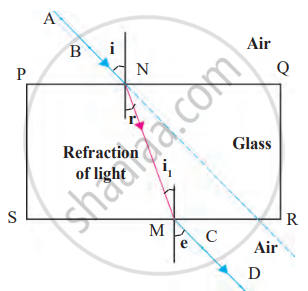
Refraction of light passing through a glass slab
Observation and Explanation:
1. The incident ray (AN) strikes the glass at point N and bends due to refraction.
2. The first refraction occurs when light moves from air to glass at N, bending toward the normal.
3. The second refraction occurs when light moves from glass to air at M, bending away from the normal.
The angles of refraction are measured as:
- i = angle of incidence (AN to normal at N).
- r = angle of refraction at N.
- i₁ = r, meaning the refraction inside the glass follows the same pattern.
- e = emergent angle, which equals i due to the opposite bending effect.
The emergent ray (MD) is parallel to the incident ray (AN) but is slightly displaced from it due to the shift caused by the refraction process.
This activity shows that light bends when passing between different transparent media, following the laws of refraction. The incident and emergent rays remain parallel but are slightly displaced, demonstrating the refraction through a rectangular glass slab.
Example
For the crane:
- The fish looks 6 cm below the surface (apparent depth).
- Using n = \[\frac {\text {real depth}}{\text {apparent depth}}\] with n = \[\frac {4}{3}\]:
\[\frac {4}{3}\] = \[\frac {R}{6}\] ⇒ R = 8 cm. - So the fish is actually 8 cm below the surface, and the crane must immerse its beak 8 cm to reach it.
For the fish:
- The crane is really 6 m above the water (real height).
- Now air is taken with respect to water, so n = \[\frac {3}{4}\] = \[\frac {\text {real height}}{\text {apparent height}}\].
- \[\frac {3}{4}\] = \[\frac {6}{A}\] ⇒ A = 8 m.
- So, to the fish, the crane appears 8 m above the water surface.
