Advertisements
Advertisements
प्रश्न
Write scientific reason.
The sun appears on the western horizon for some time after sunset.
Advertisements
उत्तर
- As ray of light from the Sun enters the earth’s atmosphere, it follows a curved path due to refraction, before reaching the observer.
- This makes the apparent position of the Sun slightly higher than the actual position for the observer.
- Hence, due to the atmospheric refraction of sunlight, the observer on the earth continues to see the setting Sun for two minutes after the Sun has dipped below the horizon, thus delaying the sunset.
APPEARS IN
संबंधित प्रश्न
What is refraction of light?
Name the phenomenon responsible for the following effect:
When we sit in front of a plane mirror and write with our right hand, it appears in the mirror that we are writing with the left hand.
State whether the following statement is true of false:
A student says that we can see an object because light from our eyes is reflected back by the object.
What is lateral inversion? Explain by giving a suitable example.
What are the important differences between looking at a photograph of your face and looking at yourself in a plane mirror?
State the uses of plane mirrors.
With the help of a labelled ray-diagram, describe how a plane mirror forms an image of a point source of light placed in front of it. State the characteristics of the image formed in a plane mirror.
An object is placed 20 cm in front of a plane mirror. The mirror is moved 2 cm towards the object. The distance between the positions of the positions of the original and final images seen in the mirror is ______.
A ray of light goes from water into air. Will it bend towards the normal or away from the normal?
State whether the following statement is true or false:
Refraction occurs because light slows down in denser materials.
Fill in the following blank with suitable word:
Light bends when is passes from water into air. We say that it is ............
What is meant by ‘refraction of light’?
A ray of light travelling in air is incident on a rectangular glass block and emerges out into the air from the opposite face. Draw a labelled ray diagram to show the completer path of this ray of light. Mark the two points where the refraction of light takes place. What can you say about the final direction of ray of light?
Light travels more quickly through water than through glass.
- Which is optically denser: water or glass?
- If a ray of light passes from glass into water, which way will it bend: towards the normal or away from the normal?
When a light ray passes from air into glass, what happens to its speed? Draw a diagram to show which way the ray of light bends.
State two factors on which the lateral displacement of the emergent ray depends.
How does the light have to enter the glass:
to produce a large amount of bending?
The depth of a pond when seen from above appears to be less.
Water is optically .......... than air.
Air is optically .......... than glass.
Draw a diagram showing the refraction of a light ray from water to glass. Label on it the incident ray, the angle of incidence (/), and the angle of refraction (r)
The diagram (figure) given below shows two parallel rays 1 and 2 incident on (a) a concave mirror, (b) a convex mirror. Draw the reflected rays and mark the focus by the symbol F.
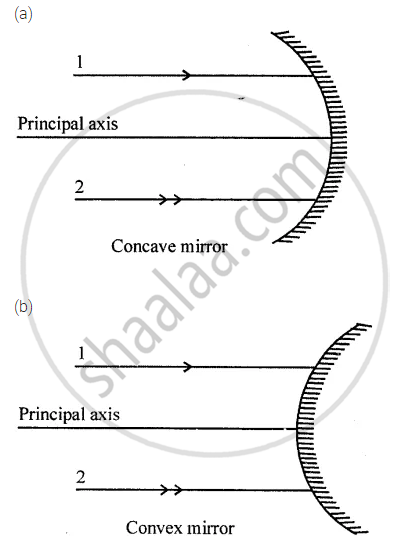
Define the principal focus of a concave mirror.
What is atmospheric reflection? Explain with the help of a labelled diagram that the position of a star as seen by us is not its true position.
Explain how the formation of a rainbow occurs.
Lights of different colours are used as signal for safety transport. From these, the wavelength of red light is _______ nm.
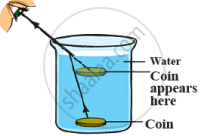
Observe the given figure and write appropriate phenomenon of light in the box.
Why does a ray of light bend when it travels from one medium to another?
What is refractive index?
You are given water, mustard oil, glycerine and kerosene. In which of these media a ray of light incident obliquely at same angle would bend the most?
The phenomenon of light passing through the object is called ______.
Light bends as it passes from one medium to another. What is this phenomenon called?
A water tank appears shallower when it is viewed from the top due to refraction.
Assertion: The air bubble shines in water.
Reason: Air bubble shines due to the refraction of light.
How do twinkling stars occur? (or) what is the cause of the twinkling of stars?
The part of light that enters into the other medium and travels in a straight path but in a direction different from its initial direction is called:
The ray that enters the second medium after crossing the boundary is called the:
According to the second law of refraction, for a given pair of media, the ratio of the sine of the angle of incidence to the sine of the angle of refraction:
A larger refractive index of a medium means that light travels:
